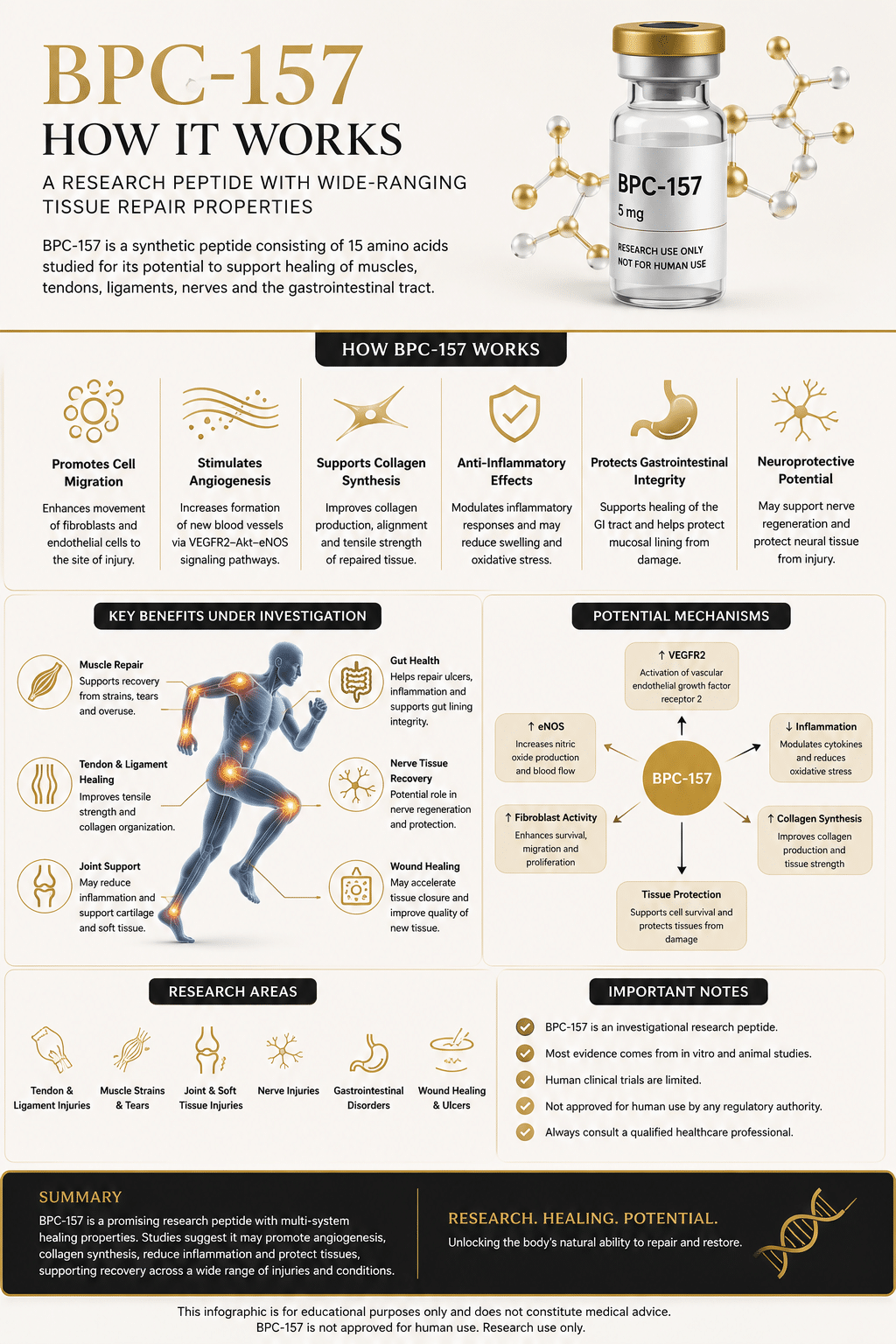
BPC-157, or Body Protection Compound 157 is a synthetic peptide consisting of 15 amino acids. It is derived from a peptide sequence which is related to the protective compounds studied in gastric tissue.
BPC-157 is of particular scientific interest for its role in tissue repair, inflammatory signalling, blood vessel regulation and gastrointestinal protection. Its effects have been studied in preclinical studies in models of tendons, ligaments, muscles, skin, bone and the digestive tract.
Effects on fibroblast activity, collagen organisation, angiogenic signalling and nitric-oxide pathways have been reported in animal and laboratory studies . But most of the evidence that has been published comes from rodents or laboratory models and the findings still need to be confirmed in large, robust clinical trials in human beings.
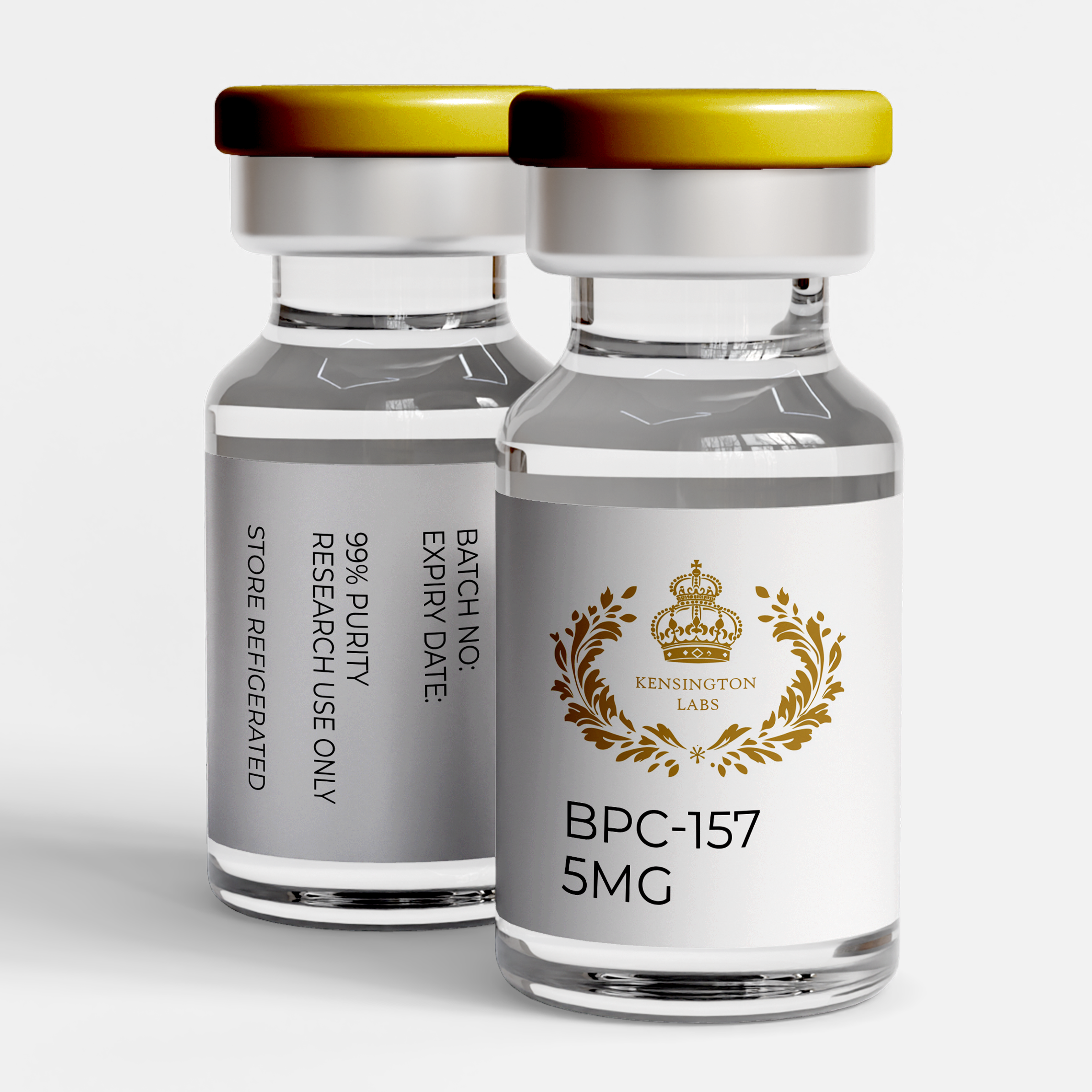
This product is supplied for laboratory research purposes only and is supplied as lyophilised powder containing 5mg BPC-157. It is not licenced as a drug and is not intended for human consumption.
Research Protocol
There is currently no established medical or regulatory approved human dosing protocol for BPC-157. Published experiments have used different routes, concentrations and periods of treatment, depending on the animal model and the tissue investigated.
Therefore, a laboratory research protocol should be built on:
The model under experimental study
The route of administration allowed for by the study
Subject weight or cell culture concentration
The biological pathway or tissue being investigated
Suitable control and comparison groups
Ethical and institutional approval
Predefined study and monitoring endpoints
Here is a typical research protocol for BPC 157
Suggested Dosage Chart
Tier
Dosage
Frequency
Notes
Weeks 1-2
200mcg
Once Daily
-
Weeks 3-4
400mcg
Once Daily
-
Weeks 5-8+
600mcg
Once Daily
-
Expected Benefits of Research
BPC-157 is under investigation for possible effects such as:
Tendon and ligament repair
Muscle recuperation
Fibroblast motility and activity
Collagen production and arrangement
Blood vessel and angiogenic signalling
Protection of gastrointestinal mucosa
Wound repair
Inflammatory signalling
Modulation of the nitric oxide pathway
bone-to-tendon healing
Recovery after experimental tissue injury
BPC-157 has been shown to improve healing of transected Achilles tendons and surgically injured ligaments in rodent studies. Laboratory work has also reported increased tendon-cell out-growth and migration. These are experimental results, not clinically proven human benefits.
How this Works
Potential Side Effects & Considerations
The adverse effect profile of BPC-157 in humans has not been sufficiently established. Lack of adverse effects in small or preclinical studies should not be considered as evidence for safety.
Some potential concerns include:
Pain, redness or swelling at the injection site
Contamination or infection from unsterile handling
Immune response / allergy
Headache, nausea or giddiness
Side effects on blood vessel formation
Unpredictable interactions with the drugs or with other peptides
Uncertain effect on blood pressure and nitric oxide signalling
Unknown long term effects.
peptide impurities, degradation products or wrong concentration
Lifestyle Factors
Video & Media
Scientific References
Staresinic M, et al. – Achilles Tendon Repair
Gastric pentadecapeptide BPC 157 accelerates healing of transected rat Achilles tendon and stimulates tendocyte growth.
Journal of Orthopaedic Science. 2003;21(6):976–983.
https://pubmed.ncbi.nlm.nih.gov/14554208/
doi:10.1016/S0736-0266(03)00110-4
Chang CH, et al. — Migration of tendon fibroblast
Pentadecapeptide BPC 157 has been demonstrated to promote tendon healing by stimulating tendon outgrowth, cell survival and cell migration.
J. Appl. Physiol. 2011.
https://pubmed.ncbi.nlm.nih.gov/21030672/
Krivic A, et al. — Repair of Tendon to Bone
Achilles detachment in rat and stable gastric pentadecapeptide BPC 157: promoted tendon-to-bone healing and opposed corticosteroid aggravation.
Journal of Orthopaedic Science. 2006.
[PubMed] [Google Scholar] [CrossRef] [PubMed] [Google Scholar]
DOI: 10.1002/jor.20096
Cerovecki T, et al. — Ligament Healing.
Pentadecapeptide BPC 157 enhances ligament healing in the rat.
Effect of a single dose of intravenous immunoglobulin on the neurodevelopmental outcome of infants with hemiplegic cerebral palsy. Effect of a single dose of intravenous immunoglobulin on the neurodevelopmental outcome of infants with hemiplegic cerebral palsy. Effect of a single dose of intravenous immunoglobulin on the neurodevelopmental outcome of infants with hemiplegic cerebral palsy.
Brcic L, et al. — Angiogenic Signalling
Modulatory effect of the gastric pentadecapeptide BPC 157 on angiogenesis in muscle and tendon healing.
https://pubmed.ncbi.nlm.nih.gov/20388964/ https://pubmed.ncbi.nlm.nih.gov/20388964/
Gwyer D et al. —Evidence Review
Gastric pentadecapeptide BPC 157 in soft-tissue healing therapy.
The review concluded that most available research was performed in small-animal models and that efficacy was not confirmed in humans.
https://pubmed.ncbi.nlm.nih.gov/30915550/
Frequently Asked Questions
BPC-157 is an experimental peptide that is being studied for its possible effects on tissue repair pathways, fibroblast activity, collagen organisation, angiogenic signalling and gastrointestinal protection.
Animal studies have shown promising results in tendon, ligament, muscle and digestive tissue injury. But BPC-157 has not been shown to heal injuries or treat medical conditions in humans.
There is no approved or clinically validated BPC-157 injection method in humans. Self injection is not risk free Risks of infection, contamination, wrong concentration, harm to tissues and immune reactions. It’s not a licenced injectable medication.
The research community, however, prefers subcutaneous (under the skin) for most injuries. Deep muscle injuries can be managed with intramuscular.
It is contingent upon the condition being treated, but BPC-157 works in a short time. Generally expect the first effects for acute injuries and inflammatory conditions in 3-7 days. Healing usually occurs significantly at 2-4 weeks with full recovery in 4-12 weeks depending on the condition and severity. * Gut problems usually resolve in 1-2 weeks, but tendons and ligaments take longer because of poor blood supply. Noting that these time frames are based on animal studies and may not directly predict human response.
BPC-157 has been studied in preclinical studies given orally, topically and by injection. But there is no approved route for general human therapy, no standard protocol for human administration.
In experimental research, BPC-157 is used to investigate biological pathways related to the following:
Tendon and ligament repair
Muscle trauma
Wound repair
Gastroprotection
Blood vessel control
Inflammatory reactions
Fibroblast & Collagen Stimulation
Bone-to-tendon healing
BPC-157 is usually administered subcutaneously in the area of injury or in the abdominal fat for systemic delivery.
Sites of injection
Local Injection Near Injury: For musculoskeletal injury (knee, shoulder, Achilles tendon, rotator cuff) subcutaneously within 1–3 cm of the injured tissue to obtain a high local concentration during the first 15–30 min before systemic diffusion occurs. Local Injection Near Injury: For musculoskeletal injury (knee, shoulder, Achilles tendon, rotator cuff) subcutaneously within 1–3 cm of the injured tissue to obtain a high local concentration during the first 15–30 min before systemic diffusion occurs. Local Injection Near Injury: For musculoskeletal injury (knee, shoulder, Achilles tendon, rotator cuff) subcutaneously within 1–3 cm of the injured tissue to obtain a high local concentration during the first 15–30 min before systemic diffusion occurs. Local Injection Near Injury: For musculoskeletal injury (knee, shoulder, Achilles tendon, rotator cuff) subcutaneously within 1–3 cm of the injured tissue to obtain a high local concentration during the first 15–30 min before systemic diffusion occurs. Local Injection Near Injury: For musculoskeletal injury (knee, shoulder, Achilles tendon, rotator cuff) subcutaneously within 1–3 cm of the injured tissue to obtain a high local concentration during the first 15–30 min before systemic diffusion occurs. Local Injection Near Injury: For musculoskeletal injury (knee, shoulder, Achilles tendon, rotator cuff) subcutaneously within 1–3 cm of the injured tissue to obtain a high local concentration during the first 15–30 min before systemic diffusion occurs. Local Injection Near Injury: For musculoskeletal injury (knee, shoulder, Achilles tendon, rotator cuff) subcutaneously within 1–3 cm of the injured tissue to obtain a high local concentration during the first 15–30 min before systemic diffusion occurs. Local Injection Near Injury: For musculoskeletal injury (knee, shoulder, Achilles tendon, rotator cuff) subcutaneously within 1–3 cm of the injured tissue to obtain a high local concentration during the first 15–30 min before systemic diffusion occurs. Local Injection Near Injury: For musculoskeletal injury (knee, shoulder, Achilles tendon, rotator cuff) subcutaneously within 1–3 cm of the injured tissue to obtain a high local concentration during the first 15–30 min before systemic diffusion occurs. Local Injection Near Injury: For musculoskeletal injury (knee, shoulder, Achilles tendon, rotator cuff) subcutaneously within 1–3 cm of the injured tissue to obtain a high local concentration during the first 15–30 min before systemic diffusion occurs. Local Injection Near Injury: For musculoskeletal injury (knee, shoulder, Achilles tendon, or rotator cuff), subcutaneously within 1–3 cm of the injured tissue to obtain a high local concentration during the first 15–30 min before systemic diffusion occurs. Local Injection Near Injury: For musculoskeletal injury (knee, shoulder, Achilles tendon, or rotator cuff), subcutaneously within 1–3 cm of the injured tissue to obtain a high local concentration during the first 15–30 min before systemic diffusion occurs.
Examples: Fatty tissue surrounding the knee for knee injuries. Tricep area for shoulder or elbow injuries. Outer thigh for quad or hamstring issues. Examples: Fatty tissue surrounding the knee for knee injuries. Tricep area for shoulder or elbow injuries. Outer thigh for quad or hamstring issues. Examples: Fatty tissue surrounding the knee for knee injuries. Tricep area for shoulder or elbow injuries. Outer thigh for quad or hamstring issues. Examples: Fatty tissue surrounding the knee for knee injuries. Tricep area for shoulder or elbow injuries. Outer thigh for quad or hamstring issues. Examples: Fatty tissue surrounding the knee for knee injuries. Tricep area for shoulder or elbow injuries. Outer thigh for quad or hamstring issues. Examples: Fatty tissue surrounding the knee for knee injuries. Tricep area for shoulder or elbow injuries. Outer thigh for quad or hamstring issues. Examples: Fatty tissue surrounding the knee for knee injuries. Tricep area for shoulder or elbow injuries. Outer thigh for quad or hamstring issues. Examples: Fatty tissue surrounding the knee for knee injuries. Tricep area for shoulder or elbow injuries. Outer thigh for quad or hamstring issues.
Systemic Injection (Fat in Abdomen): Systemic Injection (Fat in Abdomen): Systemic Injection (Fat in Abdomen): Systemic Injection (Fat in Abdomen): Systemic Injection (Fat in Abdomen): Systemic Injection (Fat in Abdomen): Systemic Injection (Fat in Abdomen):
For deep injuries (hip joint, spinal disc) or gut related problems (IBS, gastric ulcers) inject into the lower abdominal fat for systemic absorption . For deep injuries (hip joint, spinal disc) or gut related problems (IBS, gastric ulcers) inject into the lower abdominal fat for systemic absorption . For deep injuries (hip joint, spinal disc) or gut related problems (IBS, gastric ulcers) inject into the lower abdominal fat for systemic absorption . For deep injuries (hip joint, spinal disc) or gut related problems (IBS, gastric ulcers) inject into the lower abdominal fat for systemic absorption . For deep injuries (hip joint, spinal disc) or gut related problems (IBS, gastric ulcers) inject into the lower abdominal fat for systemic absorption . For deep injuries (hip joint, spinal disc) or gut related problems (IBS, gastric ulcers) inject into the lower abdominal fat for systemic absorption . For deep injuries (hip joint, spinal disc) or gut related problems (IBS, gastric ulcers) inject into the lower abdominal fat for systemic absorption .
The abdomen is also a common spot for general use if you are not targeting a specific injury. The abdomen is also a common spot for general use if you are not targeting a specific injury. The abdomen is also a common spot for general use if you are not targeting a specific injury. The abdomen is also a common spot for general use if you are not targeting a specific injury. Alternate between left and right side to prevent irritation Alternate between left and right side to prevent irritation Alternate between left and right side to prevent irritation Alternate between left and right side to prevent irritation
Other Sites Optional: Other Sites Optional: Other Sites
Upper hip (above waistband) for site rotation or for patients with limited abdominal fat. Upper hip (above waistband) for site rotation or for patients with limited abdominal fat. Upper hip (above waistband) for site rotation or for patients with limited abdominal fat.
Easy access and comfort to the outer thigh's middle third
It depends on the country, how the product is presented, and the intended use of the product.
BPC-157 is not an approved medicine in the UK. If a product is advertised or presented as treating, preventing or repairing a human medical condition, it may be caught by medicines legislation and require appropriate authorisation from the MHRA. Something labelled “for research use only” does not mean that regulatory obligations go away if the broader presentation suggests intended human use.
BPC-157 is also banned at all times for athletes governed by the rules of the World Anti-Doping Agency. It is included in the S0 Non-Approved Substances category of the 2026 Prohibited List.
We at Kensington Labs are proud to offer Premium research grade BPC 157, laboratory tested by a third party for purity and strength.
The amount depends on the concentration the laboratory protocol requires. You will not increase the amount of BPC-157 in the vial; rather, you dilute the solution more by adding more water.
Some common concentration calculations are:
5,000mcg/ml or 50mcg in 0.01ml, 1ml added
Added 2ml 2,500mcg/ml or 25mcg per 0.01ml
3 ml added: ~1,667 mcg/ml or 16.7 mcg/0.01 ml
BPC-157 clears from the bloodstream within hours, but its biological effects can last for days to weeks.