How Does Retatrutide Work? Triple-Receptor Mechanism Explained
How Retatrutide Works: At a Glance
triple-receptor mechanism.
|
What receptors does retatrutide activate?
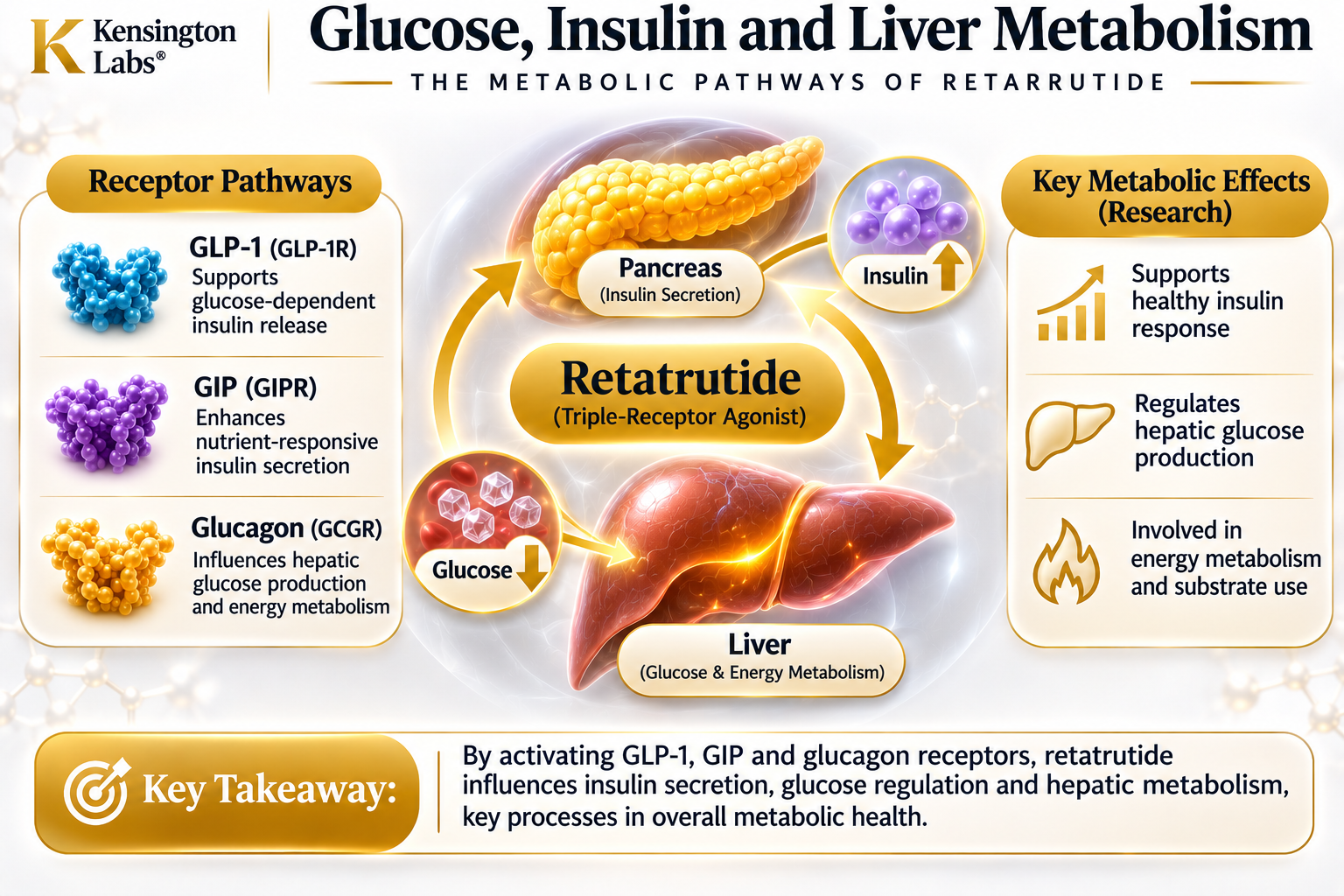
Retatrutide activates GLP-1, GIP
and glucagon receptors. It is one investigational molecule, not a mixture of three peptides. |
What does the GLP-1 receptor do?
GLP-1 signalling is involved in
appetite regulation, gastric emptying and glucose-dependent insulin secretion. |
|
What does the GIP receptor do?
GIP signalling contributes to
glucose-dependent insulin secretion and nutrient-responsive metabolic regulation. |
What does the glucagon receptor do?
Glucagon receptor signalling
influences hepatic glucose production and other aspects of energy metabolism. |
|
Does retatrutide directly burn fat?
That description is too simplistic.
Weight changes involve several physiological pathways, and individual receptor contributions remain under investigation. |
How is it different from tirzepatide?
Tirzepatide activates GIP and GLP-1
receptors. Retatrutide also activates the glucagon receptor, giving it three receptor targets. |
Triple-receptor action: what belongs in the mechanism guide
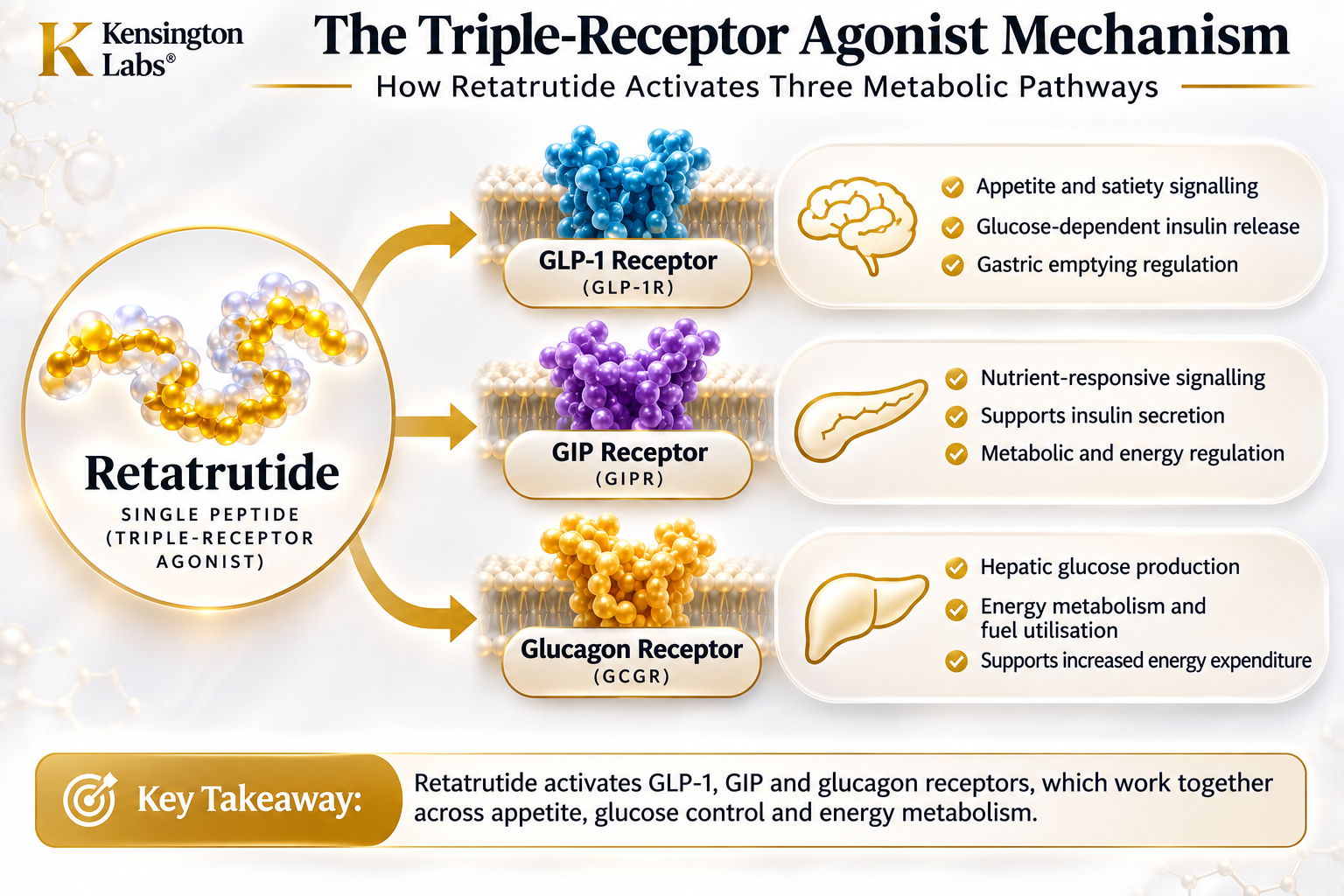
Retatrutide is a single investigational peptide engineered to activate three receptors: GIPR, GLP-1R and GCGR. It is not a mixture of three separate peptides. The relevant distinction is receptor agonism, not the number of ingredients in a vial.
GLP-1 receptor signalling is associated with appetite regulation and glucose-dependent insulin secretion; GIP receptor signalling participates in nutrient-responsive endocrine regulation; and glucagon receptor signalling is involved in hepatic glucose and energy metabolism. The overall clinical effect cannot be inferred by simply adding three individual receptor effects together.
Preclinical receptor potency and human weight-loss endpoints measure different things. The receptor pharmacology is described in Coskun et al., Cell Metabolism (2022), DOI: 10.1016/j.cmet.2022.07.013. Clinical effects require independent controlled-trial evidence.
Primary reference: Coskun et al. (2022), Cell Metabolism
Quick Answer
Retatrutide works by activating three hormone receptors: GLP-1, GIP and glucagon. These receptors participate in appetite, glucose regulation and energy metabolism. The combined signalling is being investigated in clinical trials, but receptor activity alone cannot predict a person’s outcome or establish long-term safety.
What does retatrutide do in the body?
Retatrutide is designed to activate three receptors involved in metabolic signalling. The combination is being studied for its effects on appetite, body weight and metabolic measurements. These actions should not be reduced to a single claim such as “it burns fat”; observed weight changes arise from interacting physiological pathways.
The strongest direct evidence comes from controlled human studies of clinical outcomes. Receptor-level explanations provide biological context but do not establish how a particular individual will respond.
What is a triple receptor agonist?
An agonist is a molecule that activates a receptor. A triple receptor agonist activates three receptor systems; for retatrutide these are GLP-1, GIP and glucagon. “Triple” describes the number of targeted receptor types, not three separate peptides mixed together.
Retatrutide is a single investigational molecule with activity at all three targets. This is why the terms “three peptides in retatrutide” and “GLP-3” can be misleading.
How does GLP-1 receptor activation work?
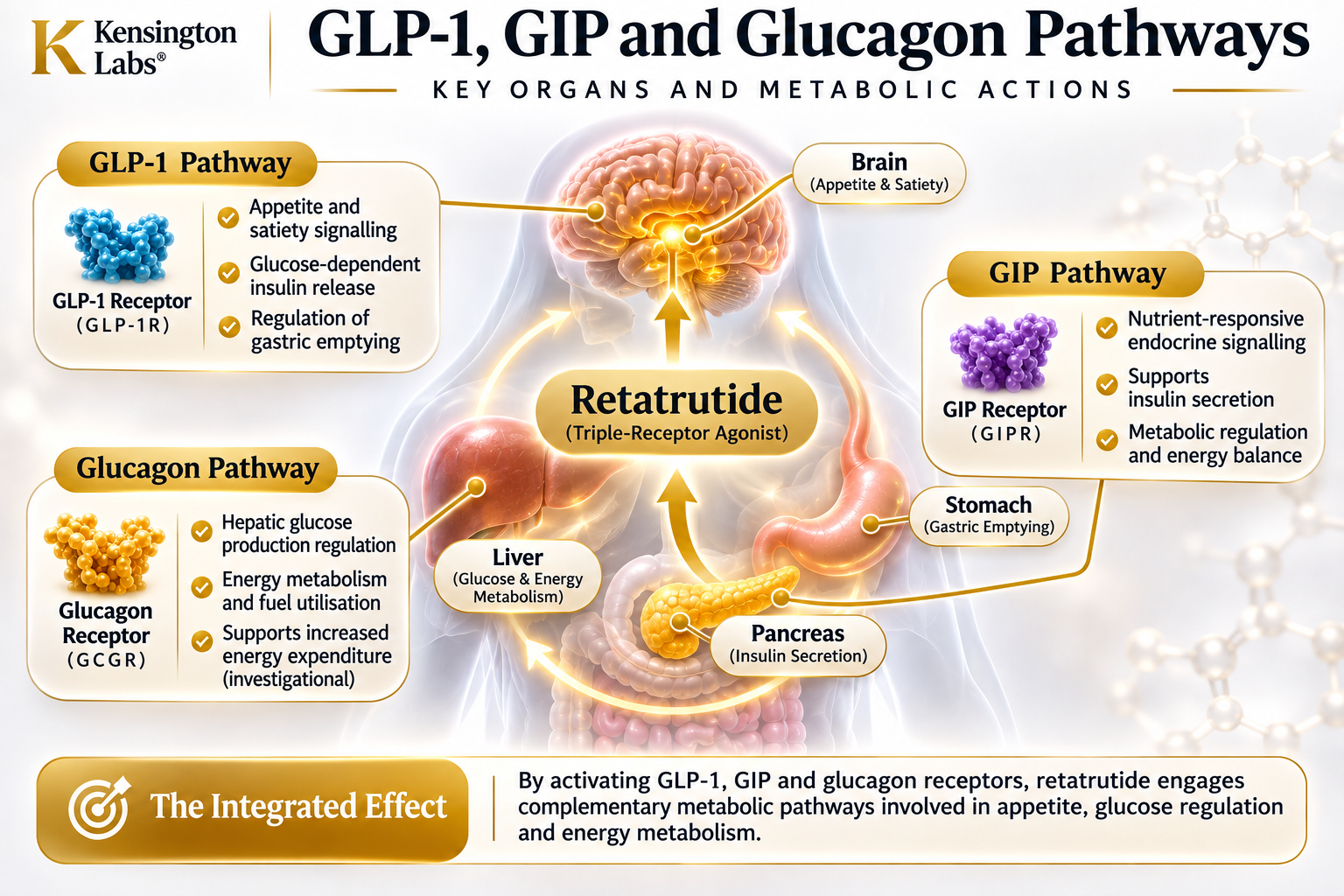
GLP-1 receptor signalling is involved in glucose-dependent insulin secretion, glucagon regulation and pathways affecting appetite and gastric emptying. The exact effects of a multi-receptor agonist cannot be assumed to equal those of a selective GLP-1 receptor agonist.
In a mechanism article, it is useful to separate well-established physiology of the GLP-1 receptor from the specific clinical effects actually demonstrated for retatrutide.
What role does the GIP receptor play?
GIP stands for glucose-dependent insulinotropic polypeptide. It is an incretin hormone whose receptor participates in glucose-dependent insulin secretion and metabolic regulation. The interaction of GIP signalling with GLP-1 and glucagon pathways is an active area of research.
It would be an oversimplification to attribute any specific percentage of weight change to GIP receptor activity without evidence that isolates that contribution.
What does glucagon receptor activation do?
Glucagon receptor signalling influences hepatic glucose production and other aspects of energy metabolism. It is biologically distinct from GLP-1 receptor signalling despite the similarity of their names.
In a triple agonist, researchers are investigating how glucagon receptor activation interacts with the other two pathways. The net human effects must be assessed in trials rather than predicted from a single receptor in isolation.
How do the three receptor pathways interact?
The proposed rationale for multi-receptor agonism is that coordinated activity across GLP-1, GIP and glucagon receptors may affect several metabolic processes at once. However, the relative contribution of each receptor to a measured clinical outcome is not necessarily known.
A useful way to interpret the evidence is to distinguish receptor binding and activation (pharmacology), physiological effects (mechanism), and measured patient outcomes (clinical trials). These are related but different levels of evidence.
How might retatrutide influence appetite?
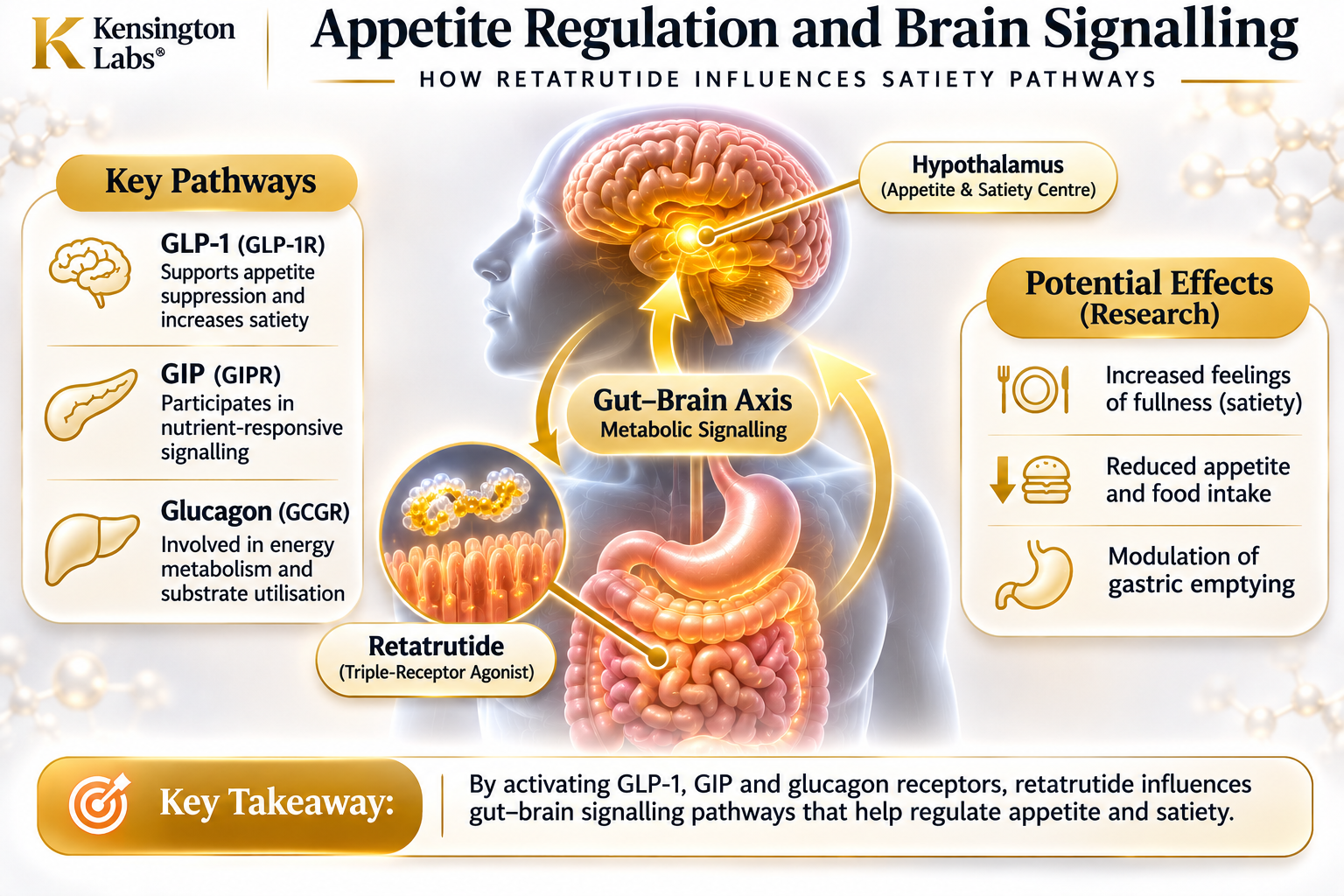
GLP-1-related signalling is associated with appetite and satiety regulation. Retatrutide trials have reported body-weight outcomes consistent with meaningful metabolic effects, but appetite responses and their timing can vary.
Does retatrutide increase energy expenditure or burn fat?
Glucagon receptor activity is one reason investigators are interested in possible effects on energy metabolism. Nevertheless, statements that retatrutide directly “burns fat” can be misleading unless the particular outcome and supporting study are specified.
Clinical body-weight changes reflect multiple processes and do not, by themselves, establish how much change is attributable to energy expenditure versus food intake or other factors. See weight-loss research for clinical outcomes.
How does retatrutide affect glucose and insulin signalling?
GLP-1 and GIP receptor pathways are involved in glucose-dependent insulin responses. Glucagon receptor activity has distinct effects on hepatic glucose metabolism. Their combination is being investigated for overall metabolic effects.
Because glucose regulation is complex, simplified claims such as “all three receptors lower blood sugar” are scientifically inaccurate. Interpretation depends on the integrated physiological response and measured trial endpoints.
What is the difference between mechanism and clinical results?
A mechanism-of-action explanation describes how a compound interacts with biological targets. Clinical results describe what was measured in participants—for example, mean change in body weight over a defined number of weeks.
In the 2023 phase 2 obesity trial, investigators reported substantial average weight reductions at 48 weeks in certain study arms. Those results do not prove which receptor contributed what proportion of the effect, nor do they guarantee outcomes outside the study.
How is retatrutide mechanistically different from semaglutide and tirzepatide?
Semaglutide is a GLP-1 receptor agonist. Tirzepatide is a dual GIP/GLP-1 receptor agonist. Retatrutide is being investigated as a GLP-1/GIP/glucagon triple receptor agonist.
Different receptor profiles provide a mechanistic distinction, but do not automatically establish superiority. Cross-trial comparisons can be distorted by differences in populations, follow-up periods and methods.
How quickly does the mechanism translate into clinical effects?
Receptor activation and observable changes in appetite, glucose measures or body weight are not the same thing. Clinical endpoints are measured over specific time frames, and the timing of an effect cannot be inferred simply from the receptor targets.
What remains uncertain about the mechanism?
Open questions include how much each receptor contributes to specific outcomes, how effects vary among populations, and which long-term benefits and adverse events emerge in larger studies.
A strong scientific summary should be explicit about those uncertainties. A receptor-level hypothesis is useful context, not proof of a clinical benefit or assurance of safety.
Frequently Asked Questions
How does retatrutide work?
Retatrutide activates GLP-1, GIP and glucagon receptors. Researchers are studying how their combined signalling affects appetite, body weight and metabolic outcomes.
What does retatrutide do?
It engages three metabolic receptor pathways and has been studied for effects on weight and metabolic measures in clinical trials.
What does retatrutide do to your body?
It activates receptors involved in appetite, glucose and energy metabolism. The clinical effects and adverse events must be interpreted from controlled studies.
What three things does retatrutide target?
It targets the GLP-1, GIP and glucagon receptors.
Is retatrutide three peptides?
No. It is one investigational molecule with agonist activity at three receptor types.
What is retatrutide’s mechanism of action?
Its mechanism is triple agonism at GLP-1, GIP and glucagon receptors.
What does the GLP-1 component do?
GLP-1 receptor signalling contributes to glucose-dependent insulin responses and appetite-related pathways.
What does the GIP component do?
GIP receptor signalling participates in glucose-dependent insulin secretion and metabolic regulation.
What does glucagon receptor activation do?
It affects hepatic glucose regulation and other metabolic pathways; its net effect in triple agonism is studied in clinical trials.
Does retatrutide directly burn fat?
That is too simplistic. Researchers measure weight and metabolic outcomes; the contribution of individual pathways needs specific evidence.
Does retatrutide work like tirzepatide?
They share GLP-1 and GIP receptor targets, but retatrutide also activates the glucagon receptor.
How does retatrutide influence appetite?
GLP-1-related signalling is associated with appetite regulation, but individual responses and clinical timing are not determined by mechanism alone.
How long does retatrutide take to work?
Trial outcomes are measured over defined weeks or months. A mechanism description cannot predict when any individual will notice an effect.
What does retatrutide target?
The GLP-1, GIP and glucagon receptors.
What is the evidence for retatrutide’s effects?
Peer-reviewed clinical trials provide outcome evidence; receptor pharmacology explains possible biological pathways.
Can the three receptors explain every effect?
No. Their relative contributions and longer-term implications remain subjects of research.
Scientific References
- Jastreboff AM et al. Triple–Hormone-Receptor Agonist Retatrutide for Obesity — A Phase 2 Trial. New England Journal of Medicine (2023).</a >
- ClinicalTrials.gov: Phase 2 study of LY3437943 in participants with obesity (NCT04881760).</a >
Published findings reflect the populations, doses and time frames studied. They should not be extrapolated to untested products or individual outcomes.