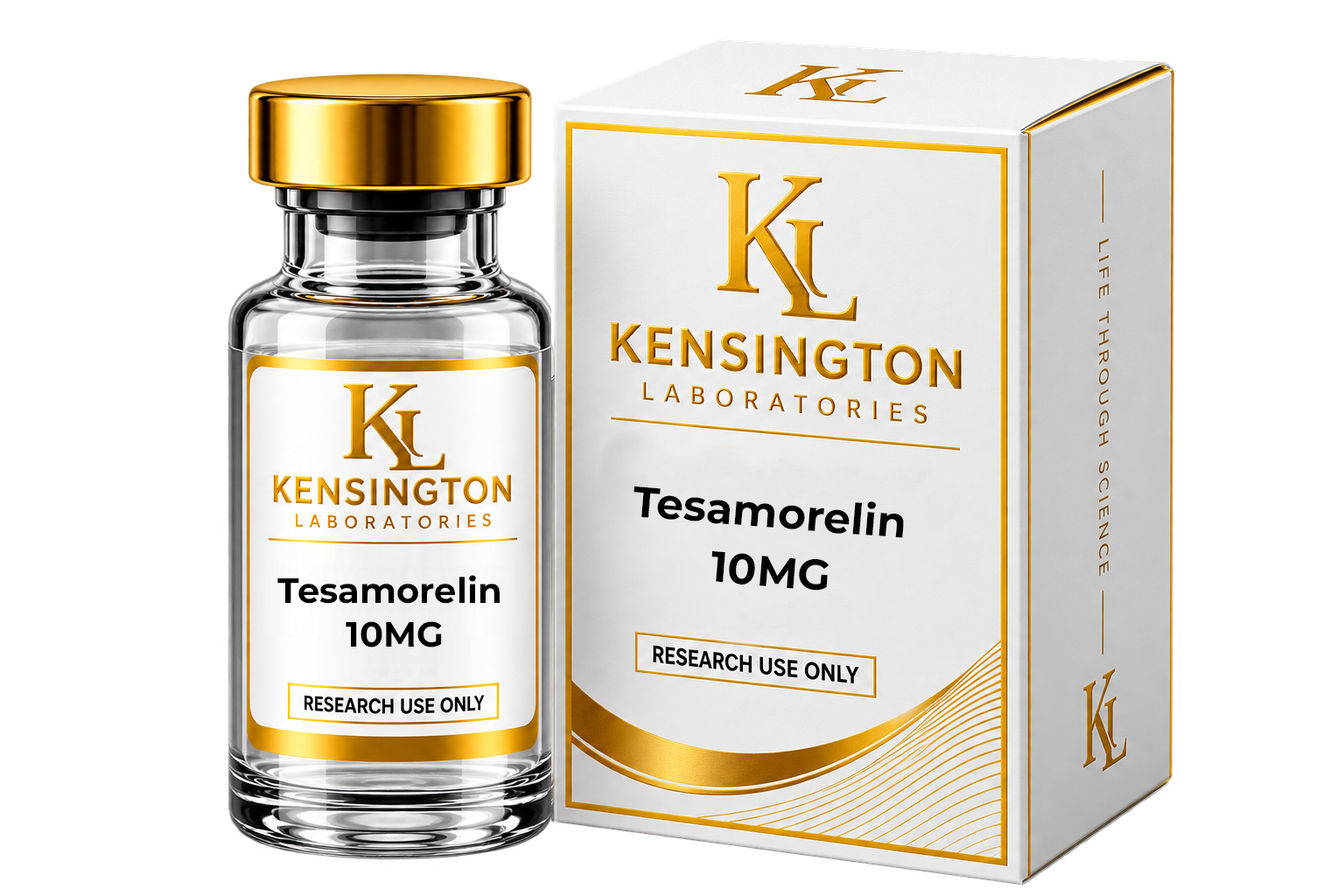
Other products in this category are here Growth Factor Research
KENSINGTON LABS | RESEARCH LIBRARY
Tesamorelin Peptide
Mechanism of Action, Visceral Fat Research and Clinical Evidence
Explore the molecular characteristics of Tesamorelin, growth hormone-releasing hormone signalling, clinical investigations, visceral adipose tissue research and scientific safety considerations.
ENDOCRINE RESEARCH
44 AMINO ACIDS
Tesamorelin is a synthetic growth hormone-releasing hormone analogue consisting of 44 amino acids with an N-terminal modification designed to improve resistance to enzymatic degradation.
The Tesamorelin peptide has been investigated extensively in endocrine research, particularly in relation to growth hormone secretion, insulin-like growth factor 1 (IGF-1) and visceral adipose tissue.
Scientific interest in Tesamorelin includes its molecular mechanism, effects on visceral fat, metabolic signalling and body composition. Unlike direct growth hormone administration, Tesamorelin stimulates endogenous growth hormone release through the GHRH receptor.
This comprehensive research guide examines what Tesamorelin is, how Tesamorelin works, its clinical research history, Tesamorelin peptide benefits, side effects, formulation differences and comparisons with other growth hormone-related compounds.
FDA approval of specific Tesamorelin medicines does not extend to generic research-grade peptide materials. This article discusses scientific evidence and does not provide personal administration instructions or therapeutic recommendations.
Tesamorelin Peptide at a Glance
What Is Tesamorelin?
A synthetic 44-amino-acid analogue of human growth hormone-releasing hormone.
What Does Tesamorelin Do?
Stimulates pituitary growth hormone secretion through GHRH receptor activation.
Tesamorelin Benefits
Clinical research has demonstrated reductions in visceral adipose tissue in selected patients with HIV-associated lipodystrophy.
Is Tesamorelin FDA Approved?
Specific medicinal formulations are FDA approved for reducing excess abdominal fat in adults with HIV and lipodystrophy.
Tesamorelin vs Ipamorelin
Both influence growth hormone signalling but act through different receptor systems.
Tesamorelin Side Effects
Documented medicinal risks include elevated IGF-1, fluid retention, glucose intolerance and injection-site reactions.
01. What Is Tesamorelin Peptide?
Tesamorelin is a synthetic analogue of human growth hormone-releasing hormone, commonly abbreviated to GHRH. Its molecular structure is based on the 44-amino-acid sequence of human GHRH with an additional N-terminal modification.
Tesamorelin research has examined the relationship between pituitary growth hormone secretion, circulating IGF-1 concentrations and metabolic processes involving adipose tissue.
What Is Tesamorelin Used For?
Specific authorised Tesamorelin medicines are used in the United States to reduce excess abdominal fat in adults with HIV-associated lipodystrophy.
Experimental Tesamorelin uses include investigations into endocrine signalling, growth hormone physiology, lipid metabolism and body composition.
What Is Tesamorelin Peptide Used For in Research?
The research peptide Tesamorelin is investigated as a GHRH analogue. Laboratory studies can examine receptor activation, peptide stability and downstream biological responses.
Is Tesamorelin a Steroid?
No. Tesamorelin is a peptide rather than an anabolic steroid. Its molecular structure and mechanism differ substantially from steroid hormones.
Is Tesamorelin a Growth Hormone?
Tesamorelin is not growth hormone itself. It acts upstream by stimulating growth hormone release from the pituitary gland.
02. Tesamorelin Molecular Structure and Specifications
MOLECULAR CLASSIFICATION
44
Amino Acid Residues
Modified human growth hormone-releasing hormone analogue
| Characteristic | Scientific Description |
|---|---|
| Compound | Tesamorelin |
| Tesamorelin CAS | 218949-48-5 |
| Molecular formula | C221H366N72O67S |
| Molecular weight | Approximately 5,135.9 g/mol |
| Amino acid count | 44 |
| Classification | GHRH analogue |
| Primary receptor | Growth hormone-releasing hormone receptor |
| Research area | Endocrinology and metabolic physiology |
These molecular characteristics describe the peptide itself. Salt forms, counterions, excipients and analytical purity should be evaluated separately.
03. Tesamorelin Mechanism of Action
The Tesamorelin mechanism of action involves activation of growth hormone-releasing hormone receptors on pituitary somatotroph cells.
Tesamorelin is a GHRH analog that stimulates endogenous growth hormone secretion. Downstream effects include increased circulating insulin-like growth factor 1 and changes in metabolic signalling.
How Does Tesamorelin Work?
Simplified illustration of the biological signalling pathway.
What Does Tesamorelin Peptide Do?
Tesamorelin stimulates pulsatile GH release through pituitary GHRH receptor activation. Growth hormone subsequently influences multiple biological processes, including hepatic IGF-1 production and lipid metabolism.
The resulting Tesamorelin effects depend on physiological conditions, endocrine feedback mechanisms and the characteristics of the population being studied.
04. Tesamorelin Peptide Benefits and Scientific Evidence
Research into the benefits of Tesamorelin has primarily examined growth hormone physiology, visceral adipose tissue and metabolic outcomes.
| Research Area | Evidence Status |
|---|---|
| Visceral adipose tissue | Supported by clinical trials in selected HIV-associated lipodystrophy populations. |
| Growth hormone secretion | Established pharmacological mechanism. |
| IGF-1 concentrations | Documented increases in clinical investigations. |
| Lipid metabolism | Investigated in metabolic and endocrine studies. |
| Liver fat | Investigated in selected clinical populations. |
| Lean body mass | Changes observed in some studies; athletic benefits are not established. |
| General weight loss | Not an approved weight-management indication. |
| Muscle growth | Insufficient evidence to establish bodybuilding efficacy. |
Tesamorelin Pros and Cons in Clinical Research
Established Research Findings
GHRH receptor activation, endogenous growth hormone secretion and visceral fat changes in specific clinical populations.
Evidence Limitations and Risks
Restricted approved indication, elevated IGF-1, glucose-related risks and uncertainty surrounding unapproved applications.
05. Tesamorelin FDA Approval and Clinical History
Tesamorelin FDA approval was originally granted in the United States in 2010 for a specific medicinal formulation marketed under the Egrifta brand.
Is Tesamorelin FDA Approved?
Yes. Specific Tesamorelin medicinal products are FDA approved for reducing excess abdominal fat in adults with HIV-associated lipodystrophy.
REGULATORY EVIDENCE
Tesamorelin FDA Approval Indication
Reduction of excess abdominal fat in adults with HIV infection and lipodystrophy. Tesamorelin is not indicated for general weight-loss management.
Tesamorelin FDA Approval: HIV Lipodystrophy
The FDA approval of Tesamorelin followed clinical investigations examining changes in visceral adipose tissue among adults with HIV-associated abdominal fat accumulation.
Tesamorelin FDA Approval and Visceral Fat
The approved indication concerns a defined clinical population. It does not establish efficacy or safety for cosmetic fat reduction, obesity management or athletic performance.
FDA Approval Status of Tesamorelin Formulations
Egrifta, Egrifta SV and Egrifta WR Tesamorelin formulations have product-specific prescribing information. Their preparation requirements and formulation characteristics should not be assumed to be interchangeable.
FDA approval of Tesamorelin medicines does not establish regulatory approval of generic research peptides or UK medicinal authorisation.
View official Tesamorelin medicinal prescribing information ↗
06. Tesamorelin Visceral Fat Reduction Research
Tesamorelin visceral fat research represents one of the most extensively investigated areas of the compound’s clinical development.
Visceral adipose tissue is located within the abdominal cavity around internal organs. It differs biologically from subcutaneous adipose tissue, which is located beneath the skin.
How Tesamorelin Targets Visceral Fat
Growth hormone signalling influences lipid metabolism and lipolysis. Clinical studies have demonstrated reductions in visceral adipose tissue following treatment with authorised Tesamorelin formulations in specific patient populations.
Tesamorelin Visceral Fat Reduction Percentage
HISTORICAL CLINICAL RESEARCH
15.2%
Mean visceral adipose tissue reduction
Reported after 26 weeks in a historical randomised clinical trial involving adults with HIV-associated abdominal fat accumulation. The placebo group experienced a mean increase of approximately 5%.
This historical Tesamorelin visceral fat reduction percentage represents a group-level clinical outcome rather than a prediction of individual results.
Tesamorelin for Belly Fat and Weight Loss
Research concerning Tesamorelin belly fat reduction must distinguish visceral adipose tissue from general body weight and subcutaneous fat.
Tesamorelin weight loss claims cannot be inferred directly from studies involving HIV-associated lipodystrophy. Tesamorelin is not approved as a general weight-loss medication.
Tesamorelin Fat Loss Efficacy and Side Effects
Clinical efficacy must be evaluated alongside documented safety considerations, including changes in IGF-1 concentrations, glucose regulation and fluid retention.
07. Tesamorelin Results and Clinical Research Timelines
Tesamorelin peptide results reported in scientific studies are specific to the formulation, population, clinical endpoints and observation period investigated.
Tesamorelin Before and After
Scientific comparisons of before and after Tesamorelin exposure typically involve objective measurements of visceral adipose tissue, body composition and endocrine markers.
Tesamorelin before and after pictures presented online cannot establish whether observed changes were caused by the compound.
Tesamorelin Before and After 1 Month
Short-term photographs or individual observations do not provide reliable evidence of clinical efficacy. Major historical investigations assessed outcomes over substantially longer periods.
Tesamorelin Visceral Fat Reduction Timeline
Initial Clinical Assessment
Measurement of relevant metabolic, endocrine and body-composition characteristics.
Primary Clinical Endpoints
Historical trials evaluated changes in visceral adipose tissue and other clinical measurements.
Extension Studies
Selected studies examined longer-term outcomes and changes following treatment continuation or withdrawal.
These are historical clinical observation periods, not recommended administration schedules.
How Long Does Tesamorelin Take to Work?
There is no universal Tesamorelin timeline applicable to every individual or formulation. Endocrine responses and measurable changes in adipose tissue are distinct biological outcomes.
Does Tesamorelin Work?
Clinical trials support the approved medicinal indication in selected populations. Evidence for other proposed applications requires separate evaluation.
08. Tesamorelin Muscle Growth and Bodybuilding Research
Scientific interest in Tesamorelin and muscle growth arises from its influence on growth hormone and IGF-1 signalling.
However, changes in circulating endocrine markers do not automatically establish improvements in skeletal muscle hypertrophy, strength or athletic performance.
Does Tesamorelin Build Muscle?
Available clinical evidence does not establish Tesamorelin as an effective muscle-building treatment for healthy individuals.
Tesamorelin Effects on Lean Mass
Changes in lean body mass have been reported in selected clinical studies. Lean mass measurements include water and other non-fat tissues and are not equivalent to direct measurements of skeletal muscle growth.
Tesamorelin Bodybuilding and Performance Claims
Claims concerning Tesamorelin benefits for bodybuilding, athletic recovery and physical performance are not supported by an established approved indication.
Research concerning Tesamorelin peptide bodybuilding applications should distinguish endocrine activity from demonstrated performance outcomes.
Does Tesamorelin Increase Testosterone?
Tesamorelin primarily acts through the GHRH receptor and growth hormone axis. It is not an established testosterone replacement or testosterone-enhancing treatment.
Does Tesamorelin Affect Fertility?
Available evidence does not establish predictable fertility-related benefits. Tesamorelin is contraindicated during pregnancy under US medicinal prescribing information.
09. Tesamorelin Research in Men and Women
Clinical investigations have included both male and female participants. Interpretation of sex-specific outcomes requires consideration of study design, population characteristics and statistical limitations.
Tesamorelin Benefits for Men
Tesamorelin peptide benefits for men must be interpreted within the populations and indications evaluated in clinical research. General claims concerning male hormone optimisation are not established.
Tesamorelin for Women
Research involving Tesamorelin in women requires consideration of endocrine physiology, reproductive status and the clinical safety information applicable to the specific medicinal formulation.
Benefits of Tesamorelin for Women
Available evidence does not establish a general-purpose Tesamorelin treatment for cosmetic fat reduction or body-composition optimisation in women.
Tesamorelin Before and After Men and Women
Individual Tesamorelin before and after men or Tesamorelin before and after women reports cannot replace controlled clinical measurements.
10. Tesamorelin vs Ipamorelin
Tesamorelin and Ipamorelin are structurally different peptides investigated in relation to growth hormone secretion.
Ipamorelin vs Tesamorelin: Receptor Mechanisms
The principal difference between Tesamorelin and Ipamorelin is their receptor mechanism. Tesamorelin activates the GHRH receptor, whereas Ipamorelin acts through the ghrelin receptor system.
Tesamorelin or Ipamorelin?
Scientific comparisons should be based on molecular characteristics and the evidence relevant to each compound. Differences in receptor activation do not establish that one is universally superior.
11. Tesamorelin vs Sermorelin
Tesamorelin and Sermorelin both belong to the GHRH analogue family but differ in molecular length and structural modification.
| Characteristic | Tesamorelin | Sermorelin |
|---|---|---|
| Amino acids | 44 | 29 |
| Classification | Modified GHRH analogue | GHRH fragment analogue |
| Receptor | GHRH receptor | GHRH receptor |
| Research focus | Visceral fat and endocrine physiology | Growth hormone secretion |
Sermorelin vs Tesamorelin: Scientific Differences
Sermorelin corresponds to the biologically active 29-amino-acid portion of GHRH. Tesamorelin incorporates the longer 44-amino-acid sequence with an additional modification.
Neither compound has an established approved bodybuilding indication.
12. Tesamorelin vs Retatrutide
Retatrutide and Tesamorelin influence fundamentally different biological pathways.
Tesamorelin
Primary target: GHRH receptor
Biological pathway: Growth hormone and IGF-1 signalling
Research: Visceral adipose tissue and endocrine physiology
Retatrutide
Primary targets: GLP-1, GIP and glucagon receptors
Biological pathway: Metabolic and appetite-related signalling
Research: Obesity and metabolic disease
Retatrutide vs Tesamorelin: Mechanism Comparison
Retatrutide is a triple receptor agonist, while Tesamorelin acts through the growth hormone-releasing hormone receptor.
Differences between their clinical trial populations and endpoints prevent direct comparisons of their reported efficacy percentages.
Tesamorelin and Retatrutide Together
Evidence concerning either compound individually does not establish the safety or effectiveness of combined exposure. Tesamorelin and Retatrutide stack results reported online are not equivalent to controlled combination studies.
13. Tesamorelin vs HGH
Tesamorelin and human growth hormone differ in molecular structure and biological mechanism.
| Characteristic | Tesamorelin | HGH |
|---|---|---|
| Structure | 44 amino acids | 191 amino acids in the principal human GH form |
| Receptor | GHRH receptor | Growth hormone receptor |
| Mechanism | Stimulates endogenous GH secretion | Direct growth hormone receptor activation |
| Endocrine feedback | Acts upstream within the GH axis | Provides exogenous growth hormone |
HGH vs Tesamorelin: Endocrine Signalling
Growth hormone acts directly on its receptor, whereas Tesamorelin stimulates pituitary growth hormone release. The compounds are not interchangeable.
Tesamorelin vs HGH Bodybuilding Claims
Neither differences in molecular mechanism nor changes in growth hormone signalling establish an appropriate bodybuilding regimen.
14. Tesamorelin vs CJC-1295
Tesamorelin and CJC-1295 are investigated in relation to GHRH receptor signalling, although their molecular structures and pharmacokinetic characteristics differ.
CJC 1295 vs Tesamorelin
CJC-1295 with DAC incorporates a modification intended to extend biological exposure. Tesamorelin uses a different molecular modification and has a distinct clinical development history.
CJC 1295 Ipamorelin vs Tesamorelin
Comparisons involving CJC-1295 and Ipamorelin combinations must distinguish GHRH receptor activation from growth hormone secretagogue receptor activation.
Combined receptor activity does not establish clinical superiority or safety.
15. Tesamorelin and Other Research Compound Comparisons
| Compound | Classification | Primary Research Pathway |
|---|---|---|
| Tesamorelin | GHRH analogue | GHRH receptor |
| Ipamorelin | Pentapeptide | Ghrelin receptor |
| Sermorelin | GHRH analogue | GHRH receptor |
| CJC-1295 | Modified GHRH analogue | GHRH receptor |
| Hexarelin | Growth hormone secretagogue | Ghrelin receptor |
| MK-677 | Non-peptide secretagogue | Ghrelin receptor |
| Retatrutide | Triple receptor agonist | GLP-1, GIP and glucagon |
| Pinealon | Tripeptide | Experimental cellular regulation |
| MOTS-c | Mitochondrial-derived peptide | Experimental metabolic signalling |
Tesamorelin vs MK677
MK-677, also known as Ibutamoren, is a non-peptide growth hormone secretagogue. Its receptor mechanism differs from Tesamorelin.
Hexarelin vs Tesamorelin
Hexarelin is a growth hormone-releasing peptide acting through the secretagogue receptor system, whereas Tesamorelin is a GHRH analogue.
Pinealon vs Tesamorelin
Pinealon is a three-amino-acid peptide investigated in cellular and neurological research. It is structurally and pharmacologically distinct from Tesamorelin.
16. Tesamorelin Combination Research and Evidence Limitations
Discussions concerning a Tesamorelin stack frequently involve compounds that influence endocrine or metabolic signalling. However, theoretical pathway interactions do not establish the safety or efficacy of combined administration.
Research findings for individual compounds cannot automatically be extrapolated to combinations. Combined endocrine effects, drug interactions and adverse reactions require independent evaluation.
Tesamorelin and Ipamorelin Blend
A Tesamorelin Ipamorelin blend involves two peptides acting through different receptor systems. The Tesamorelin and Ipamorelin stack is not an established approved medicinal combination.
Reports of Tesamorelin Ipamorelin results do not establish reproducible clinical outcomes.
Tesamorelin and Retatrutide Stack
Retatrutide and Tesamorelin together would involve distinct metabolic and endocrine pathways. There is insufficient established combination evidence to support a general-purpose regimen.
Tesamorelin and Sermorelin Stack
Both compounds activate GHRH receptors. Overlapping receptor activity requires consideration of potential additive endocrine effects.
Tesamorelin and HGH Stack
Combining growth hormone-releasing activity with exogenous growth hormone may alter endocrine exposure. Safety cannot be inferred from individual compound studies.
Tesamorelin and CJC 1295 Stack
Both compounds influence GHRH receptor signalling. Their combined effects require independent experimental and clinical evaluation.
MOTS-c and Tesamorelin
MOTS-c and Tesamorelin have distinct molecular characteristics and research mechanisms. Available evidence does not establish the clinical safety or effectiveness of combining them.
Tesamorelin and Mounjaro
Mounjaro contains Tirzepatide, which acts through GIP and GLP-1 receptors. Tesamorelin has a different endocrine mechanism. Potential interactions require clinical evaluation.
Tesamorelin and Testosterone Together
Testosterone and Tesamorelin influence different endocrine pathways. Their combined use cannot be assessed solely from their individual molecular mechanisms.
17. Tesamorelin Peptide Formulations
Research materials may be described using nominal peptide quantities and different presentation formats. These descriptions do not establish clinical equivalence or pharmaceutical suitability.
| Nominal Description | Scientific Interpretation |
|---|---|
| Tesamorelin 2mg | Nominal peptide quantity |
| Tesamorelin 5mg | Nominal peptide quantity |
| Tesamorelin 10mg | Nominal peptide quantity |
| Tesamorelin 20mg | Nominal peptide quantity |
| Tesamorelin 30mg | Nominal peptide quantity |
| Tesamorelin 40mg | Nominal peptide quantity |
| Tesamorelin 50mg | Nominal peptide quantity |
| Tesamorelin 60mg | Nominal peptide quantity |
These quantities are examples of terminology used in research-material descriptions. They do not represent a catalogue of available products or individual administration quantities.
Tesamorelin Peptide 10mg and Tesamorelin Peptide 20mg
Descriptions such as 10mg Tesamorelin and 20mg Tesamorelin identify nominal material quantities rather than recommended exposure levels.
Tesamorelin Vial and Tesamorelin Pen
A Tesamorelin vial and Tesamorelin peptide pen describe different presentation formats. The container or device does not establish pharmaceutical quality, sterility or clinical suitability.
Tesamorelin Injection Pen Formulations
Descriptions such as Tesamorelin 10mg pen, Tesamorelin 20mg pen and Tesamorelin 40mg pen refer to device-associated material quantities. They are not standardised clinical administration recommendations.
Tesamorelin Pre Mixed Pen
Pre-prepared peptide solutions require formulation-specific stability, sterility and analytical evidence. A pre-mixed presentation does not establish equivalence to an authorised medicine.
18. Tesamorelin Nasal Spray and Oral Formulations
Alternative peptide delivery routes present distinct challenges involving enzymatic degradation, molecular stability and biological absorption.
Tesamorelin Nasal Spray
Requires independent evidence concerning nasal absorption and formulation-specific safety.
Tesamorelin Tablets
Oral peptide delivery faces gastrointestinal degradation and absorption limitations.
Tesamorelin Capsules
Capsule presentation does not establish systemic peptide bioavailability.
Tesamorelin Injection
Authorised injectable medicines have formulation-specific clinical evidence and prescribing requirements.
Tesamorelin Peptide Oral Formulations
Tesamorelin oral tablets, Tesamorelin peptide tablets and Tesamorelin pills cannot be assumed to reproduce the pharmacological exposure achieved by authorised injectable formulations.
Tesamorelin Nasal Spray Effectiveness
Evidence supporting an injectable medicinal formulation cannot automatically establish the effectiveness of a nasal spray formulation.
Tesamorelin Nasal Spray Reviews
Individual reviews cannot confirm formulation identity, biological absorption or clinical effectiveness.
19. Tesamorelin Dosage and Clinical Evidence
Tesamorelin dosage information must distinguish authorised medicinal prescribing guidance from experimental research-material quantities.
A clinically prescribed Tesamorelin dose depends on the authorised formulation, medical indication and relevant prescribing information.
Understanding Tesamorelin Dosing Information
Research-grade Tesamorelin does not have an established personal administration regimen. Prescribing information for authorised medicines cannot be transferred directly to generic peptide materials.
Tesamorelin Dosage Per Day and Dosage Per Week
Tesamorelin daily dosage and Tesamorelin dosage per week are formulation-dependent clinical considerations. Weekly totals cannot establish equivalent pharmacological exposure.
Tesamorelin Peptide Dosage Chart
An unofficial Tesamorelin dosage chart cannot establish appropriate clinical exposure, medical suitability or formulation equivalence.
Tesamorelin Dosage Calculator
A Tesamorelin calculator performs mathematical calculations but cannot determine an appropriate clinical regimen.
A Tesamorelin dosage calculator for weight loss or a Tesamorelin dosage calculator for bodybuilding cannot establish safety or efficacy for these unapproved applications.
Tesamorelin Dosage for Belly Fat
Clinical evidence concerning visceral adipose tissue in HIV-associated lipodystrophy does not establish an appropriate regimen for general cosmetic fat reduction.
Tesamorelin Dosage for Fat Loss and Weight Loss
Tesamorelin is not approved for general weight management. An established Tesamorelin dosage for weight loss cannot be inferred from its approved indication.
Tesamorelin Dosage for Bodybuilding
There is no established approved Tesamorelin dosage for muscle growth or athletic performance.
Tesamorelin Dosage for Men and Women
A general Tesamorelin dosage for men or Tesamorelin dosage for women cannot be determined solely from sex, body weight or nominal peptide quantity.
Tesamorelin 5mg Dosage, 10mg Dosage and 20mg Dosage
Container quantities do not represent individual doses. A Tesamorelin 10mg dosage chart based solely on the quantity of research material cannot establish medical suitability.
Tesamorelin Dosage in Units
Device markings and volume measurements do not establish a peptide’s clinical potency or appropriate administration quantity.
Tesamorelin Nasal Spray Dosage
Injectable medicinal prescribing information cannot establish an equivalent intranasal exposure regimen.
20. Tesamorelin Protocol and Research Design
A scientific Tesamorelin protocol should identify the research objectives, experimental model, analytical methods, controls and relevant safety considerations.
Tesamorelin Dosage Protocol
A Tesamorelin dosing protocol published within a clinical investigation is specific to the formulation and population evaluated. It does not establish a personal research-peptide regimen.
Tesamorelin Cycle and Cycle Length
Historical clinical observation periods should not be interpreted as a recommended Tesamorelin cycle length. There is no established bodybuilding or cosmetic fat-loss cycle.
Tesamorelin Timing and Dosing Frequency
Questions concerning Tesamorelin injection frequency, Tesamorelin dosing frequency and administration timing require formulation-specific clinical guidance.
Tesamorelin and Ipamorelin Dosage
There is insufficient established combination evidence to determine a generally appropriate Tesamorelin Ipamorelin blend dosage or Tesamorelin Ipamorelin stack dosage.
Tesamorelin and Retatrutide Stack Dosage
Individual clinical studies do not establish a validated combined administration regimen.
21. Tesamorelin Half-Life, Storage and Molecular Stability
Tesamorelin half life discussions should distinguish circulating peptide exposure from downstream growth hormone and IGF-1 responses.
The pharmacokinetic half-life of a compound does not necessarily correspond to the duration of its biological effects.
Pharmacokinetics
Distribution and elimination of the peptide within a biological system.
Pharmacodynamics
Biological responses resulting from receptor activation and downstream signalling.
Chemical Stability
Maintenance of peptide integrity under defined storage and experimental conditions.
How Long Does Tesamorelin Stay in Your System?
The duration of measurable peptide exposure differs from the duration of endocrine responses. Formulation characteristics and physiological variables influence these measurements.
Tesamorelin Reconstitution
Tesamorelin peptide reconstitution involves formulation-specific considerations concerning molecular stability and analytical compatibility.
Descriptions such as Tesamorelin reconstitution 10mg, Tesamorelin 5mg reconstitution and Tesamorelin reconstitution 2mg identify different nominal material quantities. They do not establish interchangeable preparation procedures.
Tesamorelin Storage After Reconstitution
Storage conditions depend on the specific formulation, excipients, analytical stability evidence and intended experimental purpose.
Tesamorelin Shelf Life
A universal shelf life cannot be assigned to all Tesamorelin preparations. Product-specific stability documentation should be used.
22. Tesamorelin Side Effects and Safety
Tesamorelin peptide side effects have been documented in clinical investigations and authorised medicinal prescribing information.
The side effects of Tesamorelin must be evaluated alongside its endocrine mechanism and the characteristics of the population receiving treatment.
| Safety Consideration | Scientific Description |
|---|---|
| Elevated IGF-1 | A documented pharmacological effect requiring clinical consideration. |
| Water retention | Fluid retention and peripheral oedema have been reported. |
| Joint discomfort | Arthralgia and musculoskeletal symptoms may occur. |
| Glucose intolerance | Changes in glucose regulation and diabetes risk require consideration. |
| Injection-site reactions | Local redness, discomfort, swelling or itching may occur. |
| Hypersensitivity | Allergic reactions are recognised medicinal safety concerns. |
| Carpal tunnel syndrome | May occur in association with growth hormone-related fluid retention. |
| Malignancy considerations | Active malignancy is a contraindication. |
Tesamorelin Water Retention and Oedema
Tesamorelin side effects involving edema or oedema may occur through growth hormone-related fluid retention.
Tesamorelin Injection Site Reactions
Local reactions associated with authorised injectable formulations may include redness, discomfort, swelling and itching.
Tesamorelin Side Effects in Men and Women
Potential adverse effects apply to both male and female patients. Tesamorelin side effects in women additionally require consideration of pregnancy-related contraindications.
Is Tesamorelin Safe?
Safety depends on the clinical indication, formulation, medical history and appropriate monitoring. FDA approval does not establish universal safety or the suitability of research-grade preparations.
23. Tesamorelin Cancer-Related Safety Considerations
Tesamorelin stimulates growth hormone secretion and increases circulating IGF-1 concentrations. These pathways are relevant to cellular growth and proliferation.
Does Tesamorelin Cause Cancer?
Available evidence does not establish that Tesamorelin universally causes cancer. However, its influence on growth hormone and IGF-1 creates important malignancy-related safety considerations.
Can Tesamorelin Cause Cancer Progression?
Active malignancy is a contraindication under authorised US medicinal prescribing information. Patients with a history of malignancy require careful clinical assessment.
Authorised Tesamorelin medicinal prescribing information identifies active malignancy, pregnancy, disruption of the hypothalamic-pituitary axis and known hypersensitivity among its contraindications.
Tesamorelin risks should be evaluated using current medicinal prescribing information rather than assumptions based on peptide classification.
24. Tesamorelin UK Research and Regulatory Considerations
Tesamorelin UK research discussions must distinguish experimental peptide materials from authorised medicinal products.
The designation Tesamorelin peptide UK does not establish medicinal authorisation or suitability for human administration.
Tesamorelin 5mg UK, 10mg UK and 20mg UK
Descriptions such as Tesamorelin 5mg UK, Tesamorelin 10mg UK and Tesamorelin 20mg UK combine geographical and nominal material-quantity terminology. They do not establish regulatory status or pharmaceutical quality.
Tesamorelin Pen UK and Tesamorelin Tablets UK
Different presentation formats require separate consideration of formulation characteristics, intended purpose and applicable regulatory requirements.
Tesamorelin Legal UK Considerations
The legal classification of peptide materials depends on their composition, presentation, intended purpose and applicable medicines legislation.
US FDA approval does not automatically establish UK marketing authorisation.
Search the MHRA medicinal products database for current UK authorisation information.
SCIENTIFIC LITERATURE DATABASE
25. Tesamorelin Scientific Research and Clinical Literature
The following scientific publications and databases provide starting points for investigating Tesamorelin’s molecular characteristics, clinical evidence and regulatory history.
NEJM — Metabolic Effects of a Growth Hormone-Releasing Factor in Patients with HIV ↗
PubMed — Tesamorelin visceral adipose tissue research ↗
PubMed — Tesamorelin and liver fat investigations ↗
PubMed — Growth hormone and IGF-1 signalling ↗
PubMed — Tesamorelin clinical safety research ↗
ClinicalTrials.gov — Tesamorelin clinical investigations ↗
26. Frequently Asked Questions About Tesamorelin
Common questions concerning Tesamorelin peptide chemistry, clinical research, visceral adipose tissue, endocrine signalling and safety.
What is Tesamorelin peptide?
What does Tesamorelin do?
Is Tesamorelin FDA approved?
Does Tesamorelin reduce visceral fat?
Is Tesamorelin for weight loss?
How long does it take for Tesamorelin to work?
Does Tesamorelin help build muscle?
Does Tesamorelin increase appetite?
Does Tesamorelin help with sleep?
Can women take Tesamorelin?
Can you take Tesamorelin and Ipamorelin together?
Can you take Tesamorelin and Retatrutide together?
Can you take CJC 1295 and Tesamorelin together?
Can you take HGH and Tesamorelin together?
How much Tesamorelin should I take daily?
What is the best time to take Tesamorelin?
Where to inject Tesamorelin?
How often to take Tesamorelin?
What are Tesamorelin common side effects?
Does Tesamorelin cause cancer?
Does Tesamorelin affect testosterone?
Are Tesamorelin peptide reviews reliable?
Is Tesamorelin a steroid?
What is the difference between Tesamorelin and Ipamorelin?
Is Tesamorelin the same as HGH?
Is Tesamorelin nasal spray equivalent to injectable Tesamorelin?
What is the Tesamorelin half-life?
Are Tesamorelin peptides authorised medicines?
RESEARCH CONTENT
Kensington Labs Research Team
Educational content covering peptide chemistry, endocrine signalling, metabolic physiology and scientific research.
Scientific Research Disclaimer
Tesamorelin is a synthetic GHRH analogue investigated in endocrine and metabolic research. Clinical findings discussed in this article relate to the specific medicinal formulations, populations and conditions evaluated.
FDA approval of specific Tesamorelin medicinal products does not extend to generic research-grade peptide materials. Research materials are not intended for human or veterinary administration.
This article provides scientific education only and does not constitute medical advice, therapeutic recommendations or personal administration guidance.
KENSINGTON LABS • SCIENTIFIC RESEARCH LIBRARY