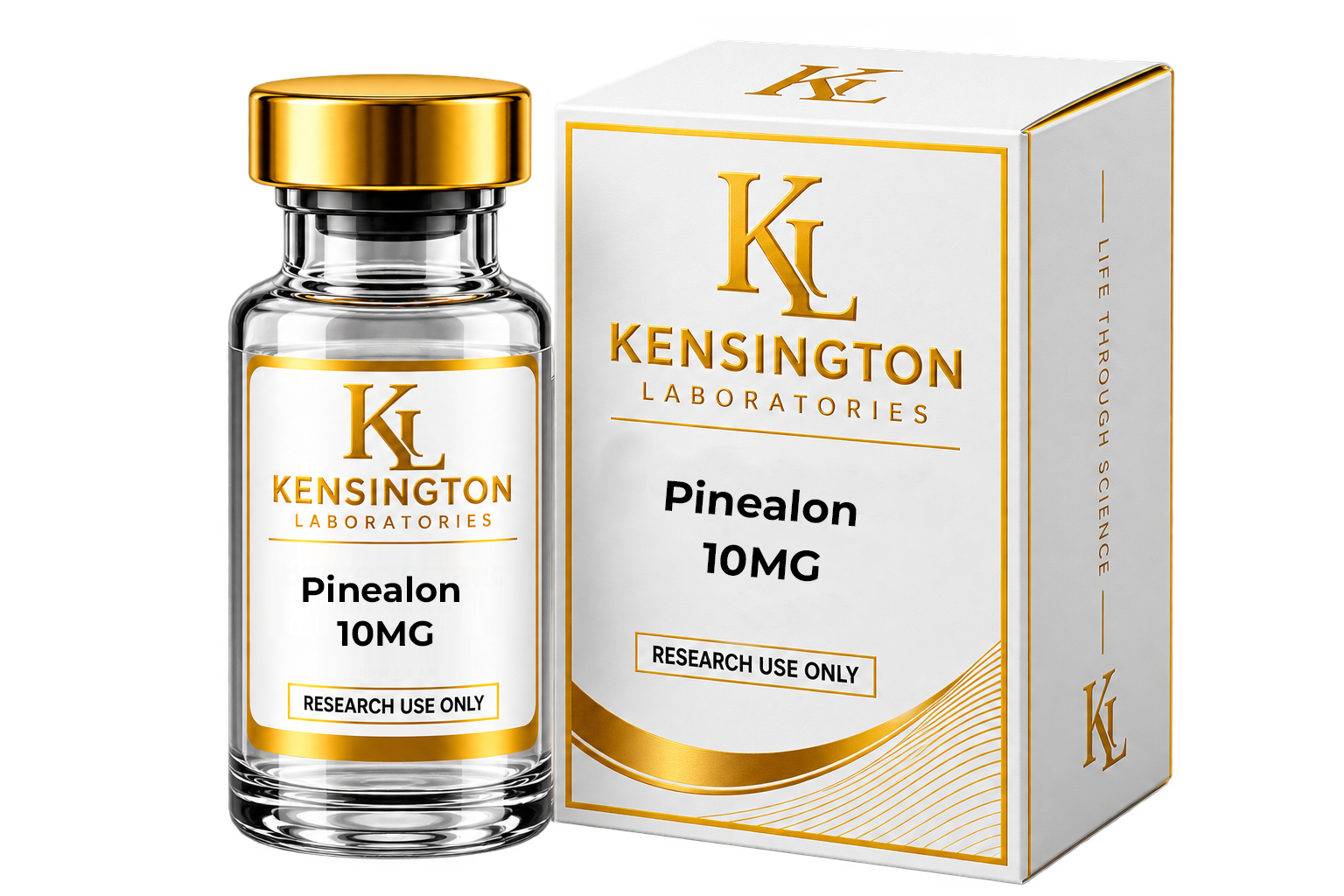
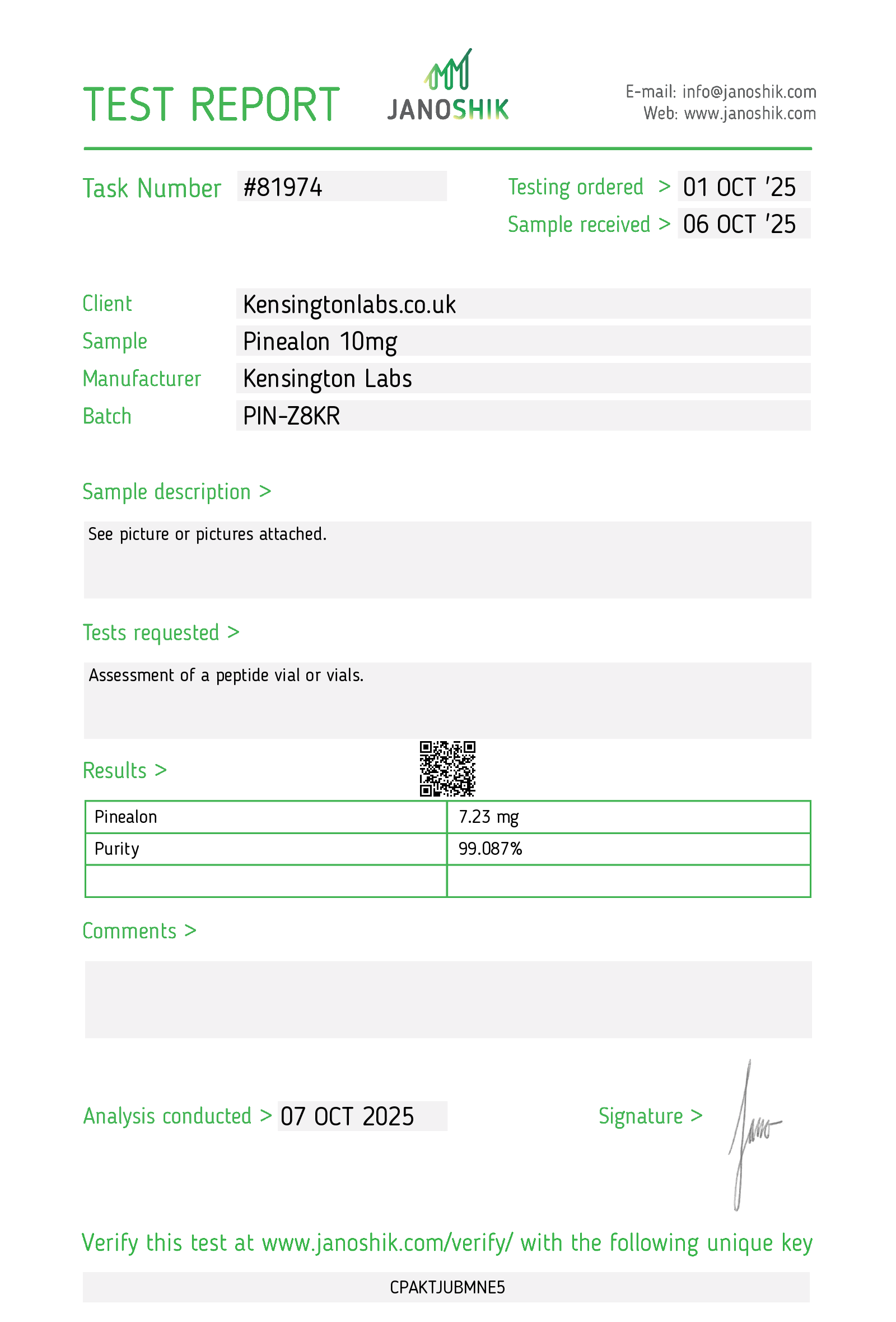
Other products in this category are here Neuroactive Research
KENSINGTON LABS | RESEARCH LIBRARY
Pinealon Peptide
Molecular Characteristics, Biological Research and Scientific Evidence
An educational overview of Pinealon, its tripeptide structure, experimental neuroscience research and comparisons with other peptide bioregulators.
NEUROACTIVE PEPTIDES
BIOREGULATOR SCIENCE
Pinealon is a synthetic tripeptide consisting of three amino acids: glutamic acid, aspartic acid and arginine. The Pinealon peptide is also identified by its abbreviated sequence, EDR, and has been investigated in experimental studies concerning cellular regulation, neuronal function and ageing-related biological processes.
Pinealon belongs to a group of short peptides commonly described as peptide bioregulators. Scientific interest in these compounds concerns the relationship between molecular structure, cellular signalling and biological regulation.
Although experimental studies have examined Pinealon, its proposed clinical applications require substantially more independent investigation.
Pinealon is an experimental research compound. Its safety and effectiveness for unrestricted human administration have not been established. This article provides scientific information and does not constitute medical advice.
Pinealon Peptide at a Glance
What Is Pinealon?
A synthetic tripeptide investigated in cellular and neuronal research.
Peptide Sequence
Glu-Asp-Arg, commonly abbreviated as EDR.
Biological Focus
Experimental neuronal systems, cellular stress and peptide bioregulation.
Clinical Evidence
Limited human evidence, with substantial uncertainties concerning clinical effectiveness.
01. What Is Pinealon?
Pinealon is a short synthetic peptide composed of three amino acids. Its molecular sequence is glutamic acid, aspartic acid and arginine, represented by the abbreviation EDR.
The compound has appeared in experimental research involving neuronal cells, oxidative stress and age-associated cellular processes.
What Is Pinealon Peptide?
The Pinealon peptide is classified as a tripeptide because its molecular structure contains three amino acid residues connected through peptide bonds.
Unlike larger proteins and peptide hormones, short peptides have relatively simple molecular structures. Their biological activity nevertheless depends on sequence, stability, cellular interactions and experimental conditions.
Pinealon Peptide: What Is It in Scientific Research?
Pinealon is investigated within the broader field of short regulatory peptides. These investigations examine whether defined amino acid sequences influence measurable cellular processes.
02. Pinealon Peptide Sequence and Molecular Structure
The Pinealon peptide sequence Glu-Asp-Arg contains three amino acids, each contributing distinct chemical characteristics to the complete molecule.
MOLECULAR SEQUENCE
Glutamic acid
—
Aspartic acid
—
Arginine
EDR | THREE AMINO ACID RESIDUES
| Characteristic | Scientific Description |
|---|---|
| Compound | Pinealon |
| Peptide sequence | Glu-Asp-Arg |
| Sequence abbreviation | EDR |
| Molecular formula | C15H26N6O8 |
| Molecular weight | Approximately 418.40 g/mol |
| Amino acid count | 3 |
| Classification | Synthetic tripeptide |
Molecular formula and weight refer to the unmodified free peptide. Salt forms and other modifications may alter analytical characteristics.
03. Pinealon Bioregulator Research
The term Pinealon bioregulator refers to the classification of Pinealon within a group of short peptides investigated for potential interactions with cellular regulatory processes.
Research involving peptide bioregulators has examined relationships between amino acid sequences, cellular signalling, gene expression and responses to environmental stress.
Cellular Regulation
Investigations into cellular responses and regulatory mechanisms.
Neuronal Research
Experimental studies involving neuronal cells and cellular stress.
Gene Expression
Research hypotheses concerning peptide interactions with regulatory pathways.
Describing Pinealon as a bioregulator does not establish that it produces beneficial clinical outcomes or reverses age-related biological changes.
04. What Does Pinealon Do?
Experimental Pinealon research has examined cellular responses under defined laboratory conditions. Areas of investigation include oxidative stress, neuronal viability and age-associated cellular changes.
The precise molecular mechanisms responsible for reported experimental observations remain incompletely characterised.
What Does Pinealon Peptide Do in Research?
These research areas should not be interpreted as established therapeutic applications of Pinealon.
05. Pinealon Peptide Benefits: Scientific Evidence
Discussions of Pinealon peptide benefits frequently refer to experimental neuroscience, cellular protection and ageing-related research.
However, proposed Pinealon benefits must be evaluated according to the type of evidence available. Findings from isolated cells or animal models do not necessarily translate into meaningful clinical outcomes in humans.
| Research Area | Evidence Consideration |
|---|---|
| Neuronal function | Experimental findings require further validation. |
| Oxidative stress | Laboratory observations are model-dependent. |
| Cognitive performance | Robust clinical effectiveness has not been established. |
| Ageing research | Experimental evidence does not establish anti-ageing benefits. |
| Sleep regulation | Insufficient evidence for a validated clinical application. |
Experimental observations should not be presented as proven Pinealon benefits for human health. Independent replication and appropriately controlled clinical studies remain necessary.
06. Pinealon for Sleep: What Does the Research Show?
Interest in Pinealon for sleep often arises from broader discussions of short peptide bioregulators, neuronal regulation and circadian biology.
However, Pinealon should not be confused with melatonin or established treatments for sleep disorders.
Pinealon Sleep Research
Pinealon sleep claims require direct investigation using validated sleep measurements, appropriate control groups and clearly defined clinical endpoints.
Research involving other pineal-associated peptides cannot automatically establish the effects of Pinealon on sleep quality, circadian rhythms or insomnia.
07. Pinealon vs Epitalon
Pinealon and Epitalon are both short synthetic peptides discussed within the field of peptide bioregulation. However, their amino acid sequences and reported experimental research differ.
Epitalon and Pinealon: Molecular Differences
Epitalon and Pinealon differ in both amino acid composition and sequence length. These structural distinctions are important when interpreting their respective experimental findings.
Epithalon and Pinealon are also discussed using alternative transliterations. Epithalon is an alternative spelling of Epitalon rather than a designation for Pinealon.
Pinealon Epitalon Comparative Research
Pinealon Epitalon comparisons require consideration of experimental conditions, molecular identity and measured biological endpoints.
Similarly, Epitalon Pinealon comparisons cannot establish comparative clinical effectiveness without appropriate direct studies.
COMPARATIVE RESEARCH
Are Pinealon and Epitalon Interchangeable?
No. Their distinct molecular sequences mean that findings involving one peptide cannot automatically be applied to the other. Evidence for combined clinical use is also insufficient.
08. Pinealon vs Tesamorelin
Pinealon vs Tesamorelin comparisons involve two structurally and pharmacologically different compounds.
While Pinealon is a synthetic tripeptide investigated in cellular research, Tesamorelin is a modified growth hormone-releasing hormone analogue with a defined endocrine mechanism.
| Characteristic | Pinealon | Tesamorelin |
|---|---|---|
| Peptide type | Tripeptide | Modified GHRH analogue |
| Amino acid length | 3 | 44 |
| Biological focus | Experimental cellular regulation | Growth hormone signalling |
| Clinical evidence | Limited | Established for specific authorised pharmaceutical indications in certain jurisdictions |
The two compounds should not be regarded as interchangeable. Their molecular structures, biological mechanisms and evidence bases differ substantially.
09. Pinealon Peptide Formulations
Peptide formulation can influence chemical stability, degradation and biological behaviour. Different Pinealon preparations require separate analytical and scientific evaluation.
Pinealon 10mg and Pinealon 20mg
Descriptions such as Pinealon 10mg and Pinealon 20mg refer to stated quantities of material. These quantities do not establish biological potency, purity or an appropriate human dose.
Pinealon Capsules
Pinealon peptide capsules require formulation-specific evidence concerning stability, absorption and biological activity.
Pinealon Tablets
Tablet formulations cannot be assumed to demonstrate equivalent biological activity to other preparations.
Pinealon Nasal Spray
Nasal formulations require independent evaluation of stability, absorption and safety.
Pinealon Supplement
Describing Pinealon as a supplement does not establish regulatory approval or suitability for consumption.
Pinealon Oral Formulations
Pinealon oral formulations are discussed in relation to peptide stability and potential absorption through the gastrointestinal tract.
Research concerning oral Pinealon must account for digestive degradation, formulation composition and the limitations of available pharmacokinetic evidence.
The description Pinealon peptide oral does not establish that an oral preparation produces the same biological effects as another formulation.
Pinealon Spray Research
A Pinealon spray represents a formulation requiring its own stability and safety evidence. Findings involving unrelated peptide sprays cannot establish the biological activity of Pinealon nasal spray preparations.
10. Pinealon Dosage and Scientific Evidence
No Established Human Dosing Recommendation
Available evidence is insufficient to establish a generally applicable, safe and effective Pinealon dosage for human administration.
Pinealon peptide dosage information must be interpreted within the context of the specific study, formulation, experimental population and measured endpoints.
A Pinealon dose reported in an experimental study cannot automatically be transferred to another formulation or used to establish a human administration regimen.
Pinealon Peptide Dosage Chart
A validated Pinealon peptide dosage chart would require reliable clinical evidence, formulation-specific pharmacokinetic information and established safety parameters.
Informal dosage charts do not provide sufficient evidence to establish safe human administration.
Pinealon Peptide Dosage Per Day
There is insufficient robust clinical evidence to establish a universally appropriate Pinealon peptide dosage per day. This resource does not provide daily administration quantities.
Pinealon Protocol and Research Design
A scientific Pinealon protocol should define the experimental model, analytical methods, control groups and measurable research endpoints.
A Pinealon peptide protocol used in one laboratory investigation cannot automatically be applied to unrelated experimental settings.
Pinealon Dosage Protocol
Information described as a Pinealon dosage protocol or Pinealon dosing protocol requires evaluation against validated clinical and pharmacological evidence.
Search terminology such as “protocol Pinealon” may refer to informal administration discussions rather than validated scientific procedures.
Pinealon Cycle
The term Pinealon cycle is sometimes used in informal discussions concerning repeated administration. Available evidence does not establish a safe or effective cycle for unrestricted human use.
11. Pinealon Human Clinical Trials
Evaluating Pinealon human clinical trials requires careful distinction between preliminary clinical reports, experimental laboratory research and large independently replicated controlled studies.
Published investigations concerning short regulatory peptides provide scientific context, but they do not establish the clinical effectiveness of every compound within this classification.
SCIENTIFIC EVIDENCE FRAMEWORK
Understanding Research Quality
Investigate cellular responses under controlled experimental conditions.
Examines biological responses within specific experimental models.
Require appropriate clinical endpoints, controls and safety monitoring.
Helps establish whether reported findings are reproducible.
Further independent clinical investigations are necessary to establish the potential clinical significance of Pinealon.
12. Pinealon Side Effects and Safety
Pinealon side effects have not been comprehensively characterised through large, independently replicated clinical safety studies.
Limited available safety information means that the frequency, severity and long-term consequences of potential adverse effects remain uncertain.
Pinealon Peptide Side Effects
Understanding Pinealon peptide side effects requires compound-specific toxicological investigations, validated clinical monitoring and appropriate assessment of formulation-related risks.
The absence of reported adverse effects in a small experimental study does not demonstrate that a compound is safe.
Current Safety Evidence
Not established
Insufficient evidence
Incompletely characterised
Requires validation
13. Pinealon UK Research Considerations
Pinealon UK research discussions should distinguish experimental laboratory materials from authorised medicinal products and established dietary supplements.
The description Pinealon peptide UK does not establish regulatory authorisation, clinical effectiveness or suitability for personal administration.
Research involving Pinealon peptides should be conducted within appropriate institutional safety and regulatory frameworks.
Further information concerning UK medicinal product regulation is available from the Medicines and Healthcare products Regulatory Agency (MHRA).
SCIENTIFIC LITERATURE DATABASE
Pinealon Scientific Research and Further Reading
The following literature searches provide starting points for evaluating published research. Individual studies should be assessed for methodological quality and relevance.
PubMed — Pinealon and oxidative stress ↗
14. Frequently Asked Questions
Common questions concerning Pinealon peptide research, molecular characteristics and scientific evidence.
What is Pinealon peptide used for?
What is the Pinealon peptide sequence?
What does the term peptide Pinealon mean?
Are Pinealon peptide benefits clinically established?
Is Pinealon effective for sleep?
What is the difference between Pinealon and Epitalon?
Are Pinealon capsules and nasal sprays equivalent?
Is there an established Pinealon dosage?
Is Pinealon the same as Tesamorelin?
Are Pinealon side effects fully understood?
RESEARCH CONTENT
Kensington Labs Research Team
Educational content covering peptide chemistry, experimental neuroscience and scientific literature.
Scientific Research Disclaimer
Pinealon is an experimental peptide with limited independently replicated clinical evidence.
This article is intended for scientific education only. It does not provide medical advice, treatment recommendations, human dosing schedules or administration instructions.
Experimental findings involving Pinealon or related peptide bioregulators should not be interpreted as established evidence of clinical safety or effectiveness.
KENSINGTON LABS • SCIENTIFIC RESEARCH LIBRARY