Other products in this category are here Regeneration Research
Kensington Labs | Regeneration Research
Glow Blend Peptide 70mg – Complete Research Guide
A comprehensive guide to Glow Blend, combining GHK-Cu, BPC-157 and TB-500 for laboratory investigation of skin biology, extracellular-matrix signalling, tissue repair and regenerative mechanisms.
Glow Blend peptide is a multi-peptide research formulation combining three compounds: GHK-Cu, BPC-157 and TB-500. Each peptide has been investigated independently in experimental studies involving cellular signalling, tissue remodelling and biological repair processes.
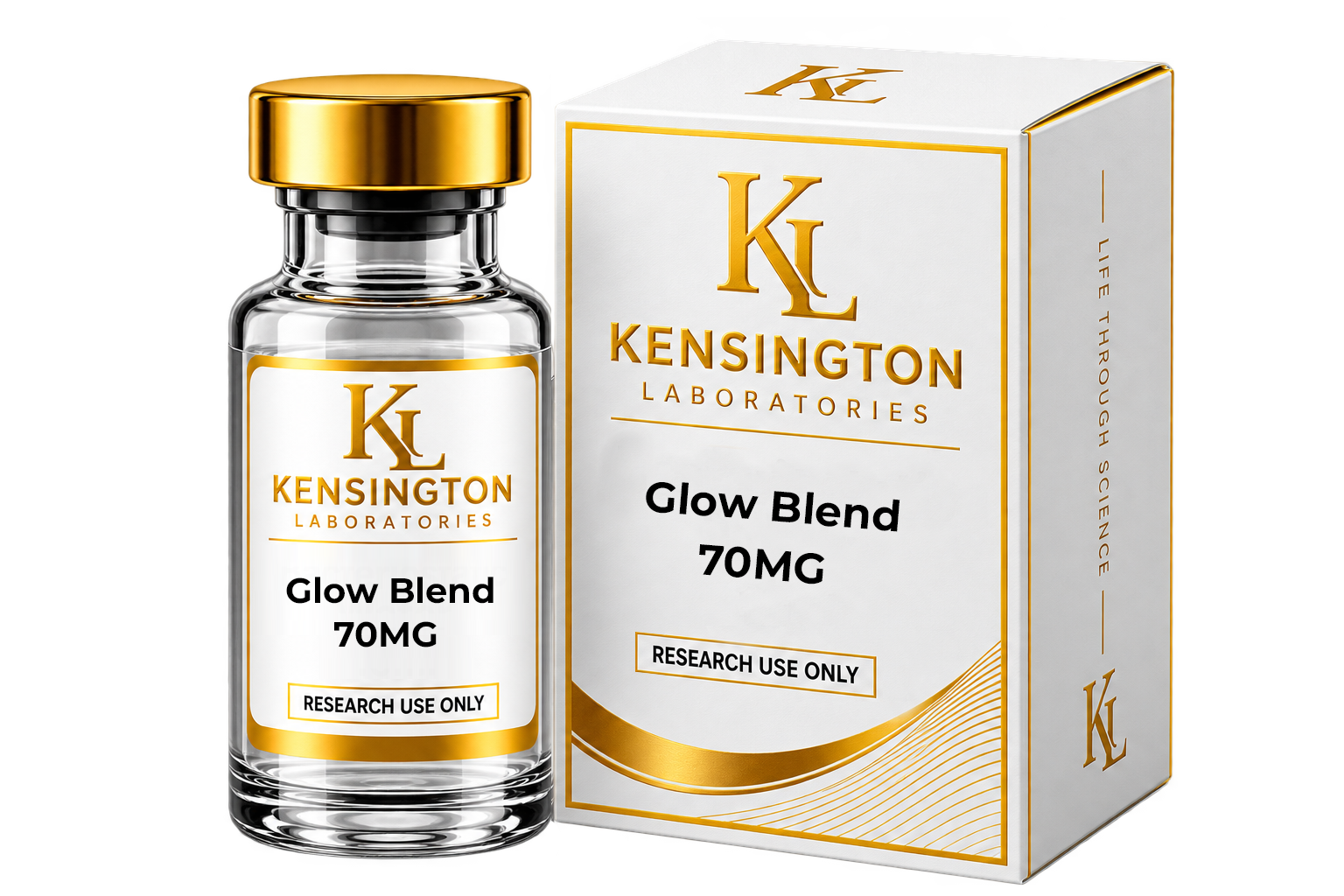
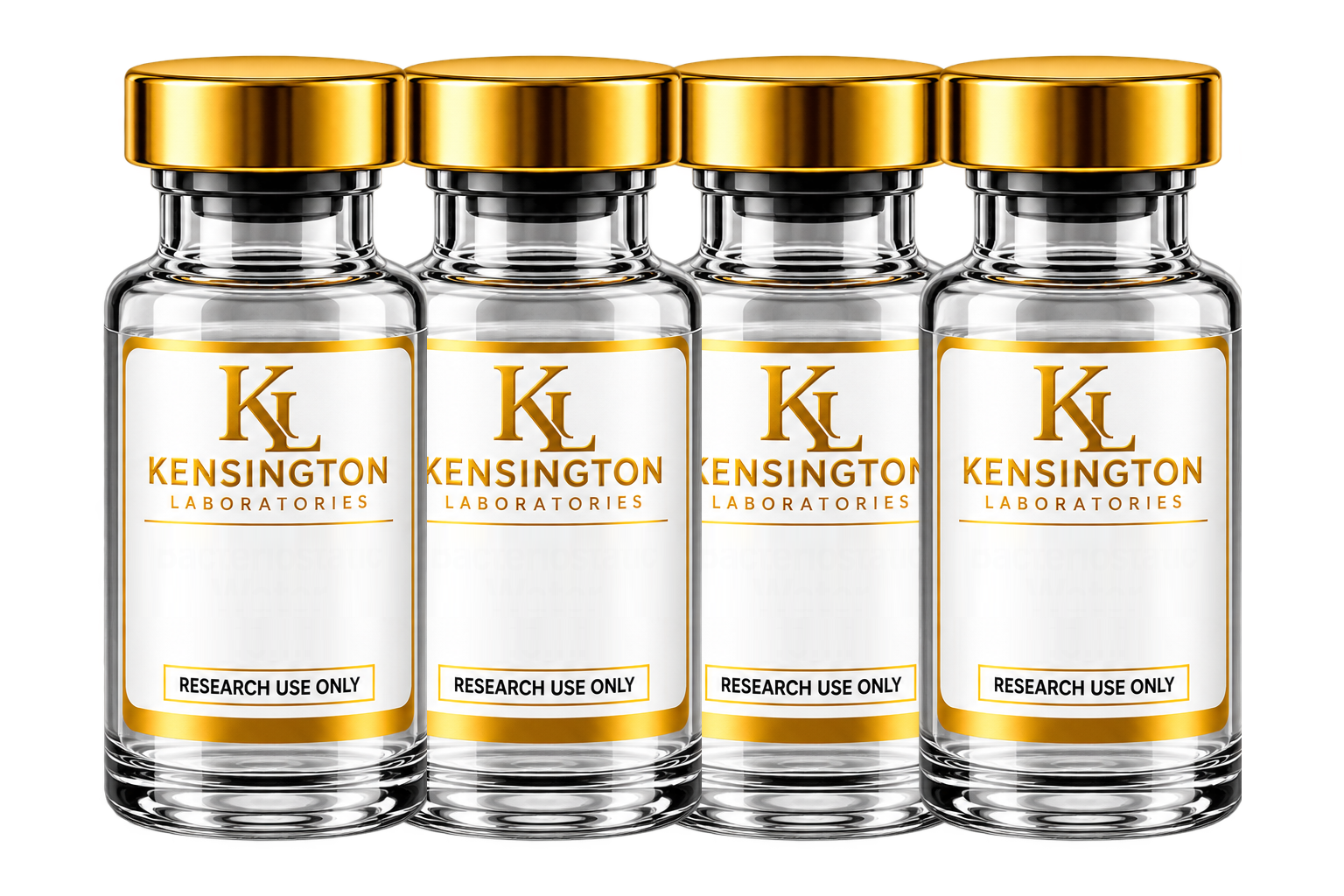
The Kensington Labs Glow Blend 70mg contains 50mg GHK-Cu, 10mg BPC-157 and 10mg TB-500. It is supplied as lyophilised research material for laboratory investigation.
Interest in the glow peptide blend comes largely from the distinct research areas associated with its ingredients. GHK-Cu is studied in relation to copper-dependent cellular processes and skin biology; BPC-157 is investigated in preclinical tissue-repair models; and TB-500 is associated with research involving thymosin beta-4-related cell migration and tissue remodelling.
These findings do not establish that the combined product produces proven anti-ageing, skin-rejuvenation or healing benefits in humans.
Kensington Labs Glow Blend is intended exclusively for laboratory research. It is not approved for human or veterinary administration, injection, cosmetic treatment or self-experimentation.
Glow Blend Peptide: Quick Research Answers
What is Glow Blend peptide?
A three-peptide research formulation containing GHK-Cu, BPC-157 and TB-500.
What is in Glow Blend 70mg?
50mg GHK-Cu, 10mg BPC-157 and 10mg TB-500, totalling 70mg of labelled peptides.
What does Glow Blend peptide do?
Its components are investigated for their effects on cellular signalling, extracellular-matrix biology and tissue-repair pathways.
What are Glow Blend benefits?
The potential benefits are research hypotheses based largely on individual ingredients, not proven clinical outcomes for the blend.
Is there a Glow Blend dosage chart?
No validated human dosage chart or administration protocol exists for this research formulation.
Is Glow Blend available in the UK?
Kensington Labs lists Glow Blend 70mg as a UK research product supplied for laboratory use only.
Glow Blend 70mg: Complete Product Composition
The Glow Blend 70mg formulation contains three peptides in defined labelled quantities. The total refers to combined peptide content, not a recommended administration amount.
| Component | Labelled Amount | Research Focus |
|---|---|---|
| GHK-Cu | 50mg | Copper peptide biology, skin and extracellular matrix |
| BPC-157 | 10mg | Preclinical tissue repair and inflammatory signalling |
| TB-500 | 10mg | Thymosin beta-4-related cell migration and remodelling research |
| Total | 70mg | Combined research formulation |
Product details: Catalogue BBG70; lyophilised powder; supplied as a research formulation. Researchers should check the relevant batch documentation for analytical results and storage information.
For comparison, the individual compounds are available as GHK-Cu Research Peptide, BPC-157 Research Peptide and TB-500 Research Peptide.
What Is Glow Blend Peptide?
Glow Blend is a commercial name used for multi-peptide formulations generally associated with skin and regeneration research. The exact ingredients and quantities can vary between suppliers, so the name alone does not define a universal chemical composition.
At Kensington Labs, the Glow Blend peptide refers specifically to a 70mg mixture containing GHK-Cu, BPC-157 and TB-500.
Unlike a single peptide, a blend contains multiple compounds that may interact with different biological systems. This makes it relevant to experimental investigations involving overlapping cellular pathways, but it also introduces additional variables into study design.
For example, if an experimental model produces a measurable change after exposure to the blend, researchers must determine whether that response is associated with GHK-Cu, BPC-157, TB-500, their interaction or another experimental factor.
Why Is It Called the Glow Peptide Blend?
The name reflects commercial interest in GHK-Cu and other peptides studied in skin-related biology. It should not be interpreted as evidence that the formulation has been clinically proven to improve skin appearance, remove wrinkles or produce a visible glow.
The Three Peptides in Glow Blend Explained
1. GHK-Cu – Copper Peptide Research
GHK-Cu is a copper-binding tripeptide investigated in relation to extracellular-matrix biology, fibroblast activity and cellular signalling.
Scientific interest includes collagen-associated processes, skin biology, oxidative stress and tissue remodelling. Some research on copper peptides involves topical formulations, which cannot automatically be generalised to systemic exposure or a multi-peptide blend.
2. BPC-157 – Tissue Repair Research
BPC-157 is a synthetic 15-amino-acid peptide investigated primarily in laboratory and animal models involving tendon, ligament, gastrointestinal and other tissue-repair processes.
Preclinical findings have explored fibroblast migration, vascular signalling, inflammatory responses and connective-tissue remodelling.
However, robust human clinical evidence remains limited, and animal findings cannot establish that BPC-157 heals injuries in people.
3. TB-500 – Cellular Migration Research
TB-500 is marketed as a peptide associated with thymosin beta-4 biology. Thymosin beta-4-related research has investigated actin regulation, cellular migration and tissue remodelling.
It is important to distinguish findings involving full-length thymosin beta-4 from those involving a particular commercial TB-500 preparation. They should not automatically be treated as interchangeable.
Research involving cell migration and repair pathways is relevant to experimental regenerative biology, but clinical effectiveness of the Glow Blend combination has not been established.
Glow Blend Peptide Benefits: What Does Research Suggest?
Searches for Glow Blend peptide benefits and Glow Blend benefits commonly relate to skin appearance, tissue recovery, inflammation and collagen biology.
These should be understood as areas of scientific investigation, not proven therapeutic benefits of the finished formulation.
Investigation of copper peptide activity, fibroblast signalling and extracellular-matrix regulation.
Experimental investigation of collagen-associated processes and connective-tissue organisation.
Study of cellular migration, tissue repair responses and remodelling pathways.
Investigation of inflammatory mediators and tissue responses in experimental models.
Glow Blend and Skin Research
GHK-Cu is the ingredient most directly associated with skin-related research. Investigations have examined copper peptide interactions with fibroblasts and extracellular-matrix processes.
Related compounds such as Matrixyl and SNAP-8 within the Regeneration Research category are also used in experimental work involving skin-associated pathways, although their mechanisms and evidence bases differ.
Glow Blend and Tissue Repair Research
BPC-157 and TB-500 are frequently discussed together because their associated research involves different aspects of tissue biology. BPC-157 has been investigated in preclinical injury models, while thymosin beta-4-related research includes cellular migration and remodelling processes.
Combining these ingredients does not establish additive or synergistic healing effects. Controlled experiments would be required to demonstrate such interactions.
Glow Blend and Inflammation
Inflammatory signalling is essential to normal tissue responses, but excessive or prolonged inflammation may contribute to disease processes.
Individual peptides associated with Glow Blend have been investigated in experimental models involving inflammatory pathways. The magnitude, direction and relevance of these effects depend on the model and study conditions.
Researchers interested in related mechanisms may also explore KPV Research Peptide.
What Does Glow Blend Peptide Do at a Cellular Level?
The proposed research rationale for peptides Glow Blend involves several biological processes that can be investigated separately.
| Research Pathway | Relevant Component | Experimental Interest |
|---|---|---|
| Fibroblast activity | GHK-Cu, BPC-157 | Cell migration and extracellular-matrix processes |
| Collagen-associated signalling | GHK-Cu | Matrix organisation and connective-tissue biology |
| Angiogenic signalling | BPC-157 and thymosin beta-4-related research | Vascular responses in experimental models |
| Cell migration | TB-500-related research | Actin-associated cell movement and remodelling |
| Inflammatory responses | Multiple components | Experimental changes in inflammatory signalling |
The table describes research interests associated with individual components or related compounds. It does not establish that all these effects occur together after exposure to the finished Glow Blend.
Does Glow Blend Peptide Work? Understanding the Evidence
There is an important difference between demonstrating a biological effect in a laboratory model and proving a treatment is effective in humans.
GHK-Cu, BPC-157 and thymosin beta-4-related compounds have each attracted scientific interest, but the evidence is not interchangeable across compounds, formulations, routes of exposure or study populations.
There is currently insufficient robust human clinical evidence to establish the efficacy or long-term safety of the Kensington Labs Glow Blend 70mg combination.
- Cell-culture findings show activity under specific experimental conditions.
- Animal studies may identify mechanisms but do not prove human outcomes.
- Research on one ingredient does not validate the three-peptide blend.
- A measurable biological response is not necessarily a clinical benefit.
- Long-term human safety requires appropriate clinical evidence.
Glow Blend Peptide Before and After: What Can Be Verified?
Searches for Glow Blend peptide before and after and Glow Blend before and after usually reflect interest in visible changes to skin appearance or recovery.
Before-and-after photographs are not reliable evidence of a treatment effect unless factors such as lighting, camera settings, skincare routines, concurrent treatments and follow-up periods are controlled.
At present, there is no established clinical dataset demonstrating consistent before-and-after outcomes for this specific 70mg blend.
Researchers evaluating cosmetic or tissue-related outcomes should use objective, predefined measurements rather than relying on promotional photographs or anecdotal reports.
Glow Blend Pen, Peptide Pen and Lyophilised Vial: What’s the Difference?
Some searches refer to a Glow Blend pen or Glow Blend peptide pen. These terms describe delivery formats rather than the identity of the peptide formulation.
The Kensington Labs Glow Blend 70mg product is listed as lyophilised powder. It should not be confused with a pre-filled pen or an approved injectable medicine.
| Format | Description | Important Distinction |
|---|---|---|
| Lyophilised vial | Dried research formulation | Does not establish injectable suitability |
| Research pen | A separate laboratory dispensing format | Not equivalent to an approved medical device or medicine |
| Pre-filled injection pen | A ready-filled administration device | Not the format described for this product |
For information about separate laboratory pen equipment, visit Kensington Labs Research Pens.
Glow Blend Injection
Searches for Glow Blend injection do not establish that a research-grade blend is appropriate for human injection. Product purity, sterility, endotoxin content, formulation stability and clinical safety are separate considerations.
This product is not supplied for injection or human administration.
Glow Blend Peptide Dosage and 70mg Dosage Questions
Popular searches include Glow Blend peptide dosage, Glow Blend dosage, Glow Blend 70mg dosage and Glow Blend dosage chart.
There is no established, clinically validated human dosage or dosing schedule for this research formulation.
The 70mg designation is the combined labelled amount of the three peptides in the vial. It is not a recommended dose, daily quantity or treatment course.
Glow Blend 70mg Composition Chart
For laboratory documentation, the following chart describes ingredient quantities rather than human dosing:
Percentage of total labelled peptide content; not a dosage recommendation.
Laboratory experiments should use methods appropriate to the research model, with validated analytical procedures and institutional safety controls.
Glow Blend Peptide Side Effects and Safety Considerations
The Glow Blend peptide side effects profile in humans has not been adequately established. There are insufficient clinical data to characterise the frequency or severity of adverse effects from the three-peptide combination.
Relevant uncertainties include:
- Potential immune or hypersensitivity reactions
- Unknown effects of repeated systemic exposure
- Possible interactions between the peptide components
- Uncertain effects on vascular and inflammatory signalling
- Potential contamination, degradation or formulation-related risks
- Lack of established long-term clinical safety data
- Uncertainty concerning interactions with medicines or existing medical conditions
Does Glow Blend Have Cancer-Related Risks?
Some of the biological pathways investigated in regenerative research, including cell migration and blood-vessel formation, are also relevant to cancer biology.
This does not demonstrate that Glow Blend causes cancer. Equally, the available evidence does not establish long-term safety in people with cancer or other serious conditions.
Such uncertainties reinforce why experimental research compounds should not be presented as clinically validated treatments.
Glow Blend Storage and Laboratory Handling
Glow Blend is supplied as lyophilised powder. Its listed storage guidance specifies protection from moisture and light, with storage at approximately -20°C.
Researchers should consult the current product label and batch-specific technical documentation, because peptide stability can vary according to formulation, temperature, moisture, light exposure and handling conditions.
Reconstitution for laboratory investigation requires a validated procedure appropriate to the intended analytical or experimental method. There is no universal preparation method that can be assumed suitable for every study.
Glow Blend 70mg Quality Testing and Certificate of Analysis
Kensington Labs provides access to its Certificates of Analysis library, where researchers can review available testing documentation.
The published Glow Blend 70mg certificate identifies analytical quantities for GHK-Cu, BPC-157 and TB-500. It also states that purity was not tested on the blend.
For this reason, it is important to distinguish between peptide quantity testing, individual-ingredient purity testing and purity testing of a finished mixture.
A Certificate of Analysis only supports the measurements actually reported. A quantity result does not independently establish blend purity, sterility, endotoxin status or suitability for clinical use. Always check that the certificate corresponds to the batch under investigation.
Glow Blend Peptide UK: Research Availability
Researchers searching for Glow Blend peptide UK or Glow Blend peptide buy may be comparing suppliers, ingredient compositions and analytical documentation.
Because Glow Blend is not a universally standardised formulation, researchers should verify the exact ingredient quantities and product format before comparing listings.
Kensington Labs lists the 70mg formulation within its Regeneration Research Peptides collection.
Availability as a laboratory research material does not mean the formulation is licensed or approved for human therapeutic or cosmetic use in the UK.
Is Glow Blend the Same as Other Glow Products?
Searches including Revion Glow Blend, Glow Blend Revion, Innermost The Glow Blend and My Blend Glow Fluid may refer to different branded products.
These names should not be assumed to describe the same formulation as Kensington Labs Glow Blend 70mg.
Products marketed for skincare, beauty, nutrition or laboratory research can differ significantly in ingredients, intended use, evidence and regulatory status.
Always compare the actual ingredient list rather than relying on the word “glow” in the product name.
Related Regeneration Research Peptides
GHK-Cu Research Peptide
Copper peptide biology, fibroblast activity and extracellular-matrix research.
BPC-157 Research Peptide
Preclinical research involving tissue repair and cellular signalling.
TB-500 Research Peptide
Thymosin beta-4-related research into cell migration and tissue biology.
KPV Research Peptide
Experimental investigations involving inflammatory pathways.
Glow Blend Peptide Frequently Asked Questions
What is Glow Blend peptide?
Glow Blend is a research formulation combining GHK-Cu, BPC-157 and TB-500. Kensington Labs supplies a 70mg version containing 50mg GHK-Cu and 10mg each of BPC-157 and TB-500.
What does Glow Blend peptide do?
Its components are investigated for their interactions with cellular migration, extracellular-matrix processes, tissue remodelling and inflammatory signalling. Clinical effects of the finished blend have not been established.
What are Glow Blend peptide benefits?
Research interests include skin biology, collagen-associated pathways and tissue repair. These are experimental areas of investigation rather than proven human benefits of the blend.
What is in Glow Blend 70mg?
The Kensington Labs formulation contains 50mg GHK-Cu, 10mg BPC-157 and 10mg TB-500.
Is there a Glow Blend peptide dosage chart?
There is no clinically validated human dosage chart for Glow Blend. The 70mg label describes the total peptide content, not an administration amount.
What is the correct Glow Blend 70mg dosage?
No approved human dosage has been established for this research-only formulation. Laboratory concentrations depend on the experimental model and validated study protocol.
Is Glow Blend available as a peptide pen?
The Kensington Labs 70mg product is listed as lyophilised powder, not a pre-filled pen. Research pen equipment is a separate product category.
Can Glow Blend be injected?
Kensington Labs Glow Blend is not supplied for human injection. Research-grade analytical testing does not establish injectable suitability or clinical safety.
What are the side effects of Glow Blend peptide?
The human adverse-effect profile is not adequately established. Possible risks include immune reactions, contamination, formulation-related effects and unknown long-term consequences.
Are Glow Blend before-and-after results proven?
No robust clinical evidence establishes predictable before-and-after results for this exact blend. Promotional photographs should not be treated as proof of efficacy.
How is Glow Blend different from GHK-Cu alone?
GHK-Cu is one copper-binding tripeptide. Glow Blend contains GHK-Cu alongside BPC-157 and TB-500, introducing additional research variables and potential interactions.
Is Glow Blend the same as a BPC-157 and TB-500 blend?
No. Kensington Labs Glow Blend 70mg contains GHK-Cu in addition to BPC-157 and TB-500. The precise composition should always be checked.
Does Glow Blend improve collagen production?
GHK-Cu has been investigated in relation to collagen-associated biological processes, but this does not prove that the combined Glow Blend improves collagen production in humans.
Is Glow Blend peptide legal in the UK?
The legal position depends on the product, intended use, claims and applicable regulatory requirements. Laboratory research availability does not constitute approval for human therapeutic or cosmetic administration.
Can I buy Glow Blend peptide in the UK?
Kensington Labs lists Glow Blend 70mg for laboratory research. It is not supplied as a medicine or for personal administration.
Where can I find the Glow Blend Certificate of Analysis?
Visit the Kensington Labs COA library and locate the certificate matching the relevant product and batch.
Explore Glow Blend and Regeneration Research
Explore Glow Blend 70mg alongside individual GHK-Cu, BPC-157, TB-500 and other research peptides used to investigate regenerative and cellular pathways.
This page provides educational information about experimental peptide research. Findings from individual compounds, laboratory models or animal studies must not be interpreted as established clinical benefits of Glow Blend 70mg. The product is supplied exclusively for laboratory research and is not intended for human or veterinary consumption, injection, diagnosis, treatment or cosmetic administration.