£43.90Original price was: £43.90.£34.95Current price is: £34.95.
👀37
people are looking at this right now
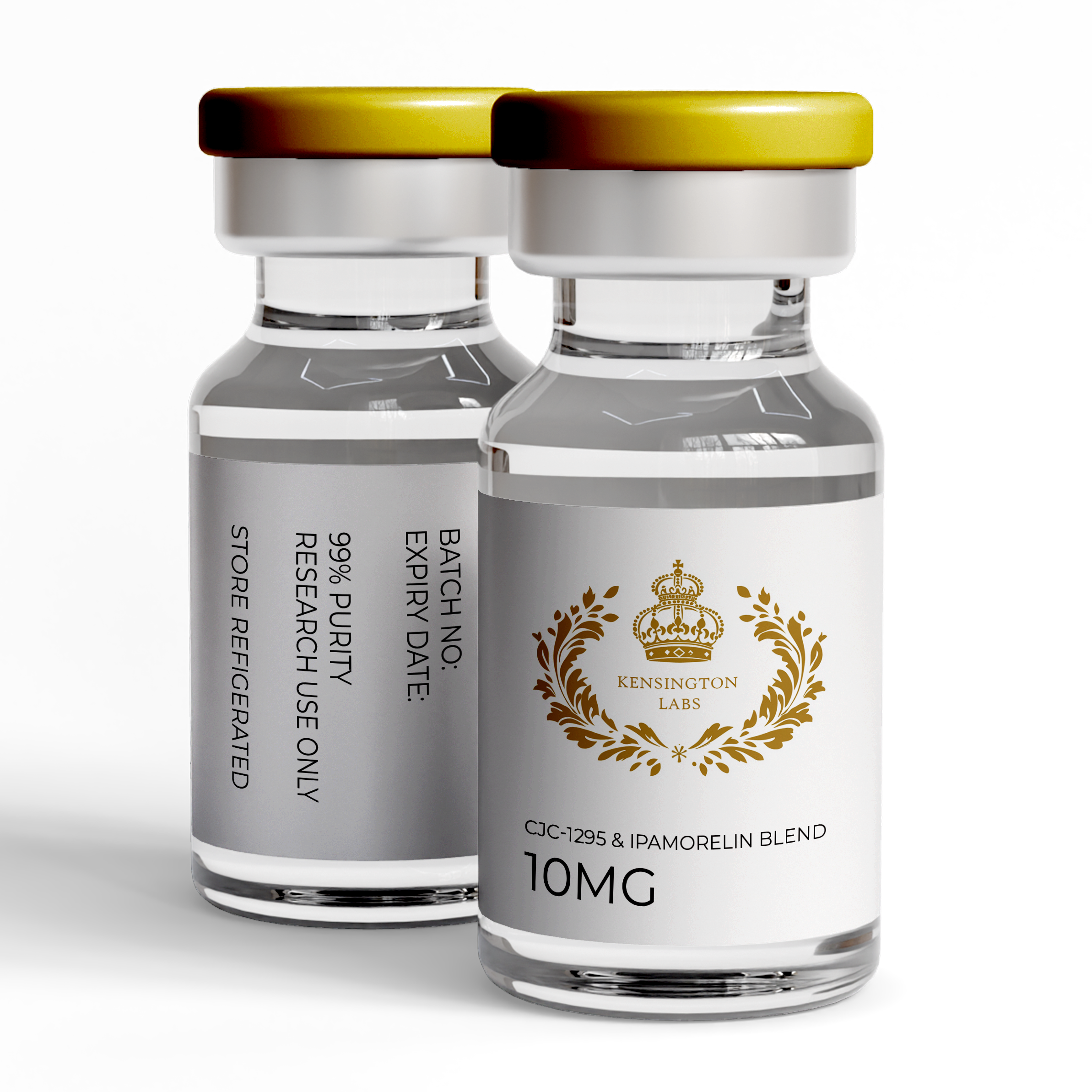
CJC-1295 (no DAC) & Ipamorelin Blend 10mg
£43.90Original price was: £43.90.£34.95Current price is: £34.95.
BUY 2, SAVE 5%
£34.95£33.20 / ITEM
BUY 3, SAVE 10%
£34.95£31.46 / ITEM
Highest Value
BUY 4, SAVE 15%
£34.95£29.71 / ITEM
33 in stock
Table of Contents
What is CJC & Ipamorelin Blend
CJC-1295 (No DAC) / Ipamorelin Blend is a combination of 5 mg CJC-1295 (modified GRF 1-29) and 5 mg Ipamorelin in one lyophilised vial.
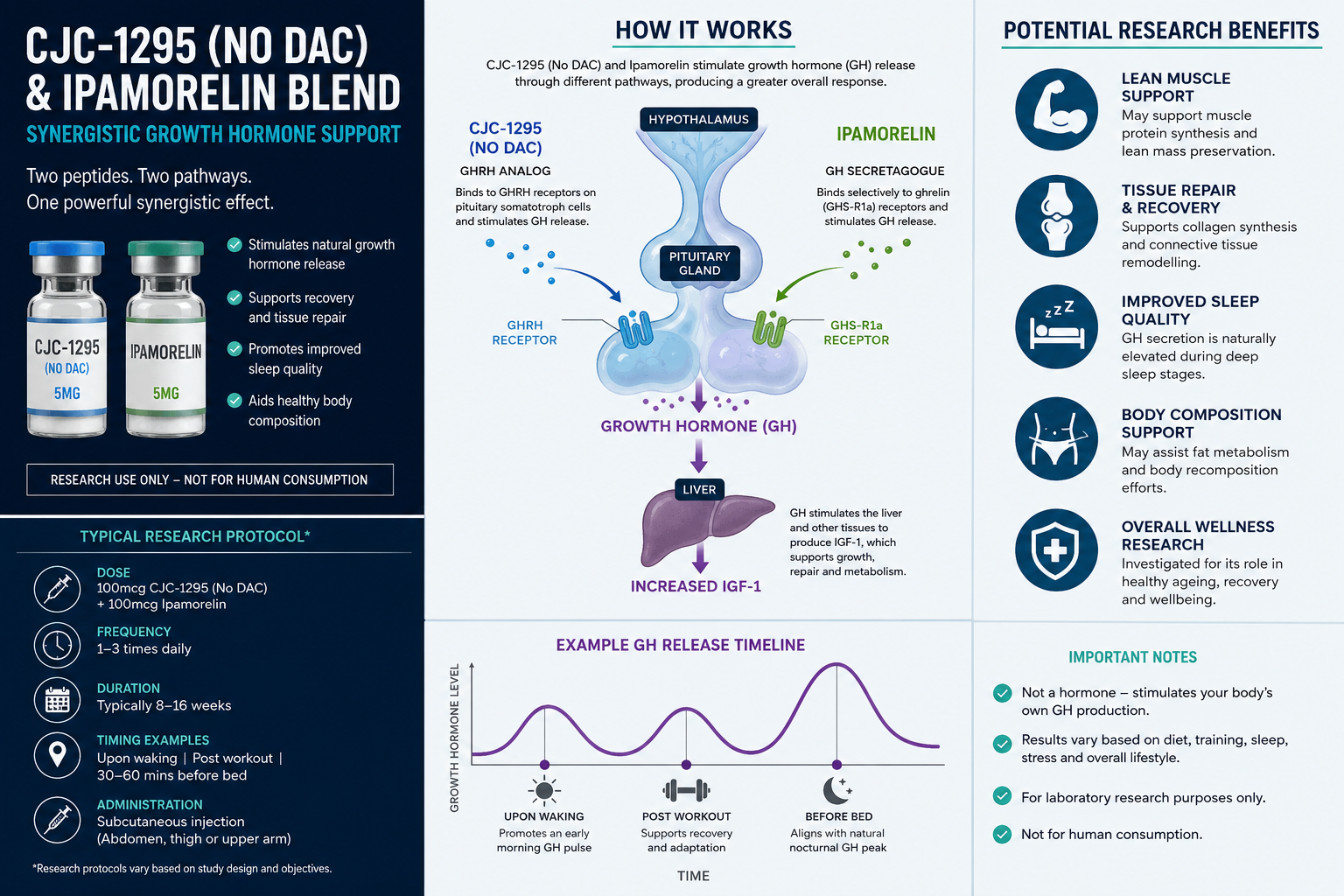
The combination is often used in research, since the peptides stimulate the release of the growth hormone via different biological pathways. CJC-1295 (no DAC) is a modified analogue of growth hormone-releasing hormone (GHRH). Ipamorelin is a selective growth hormone secretagogue (GHS) which activates the ghrelin (GHS-R1a) receptor.
The peptides have been shown to have additive effects on endogenous growth hormone release in experimental models through targeting different receptors on pituitary somatotroph cells. Unlike exogenous HGH, neither peptide contains growth hormone itself but rather stimulates the body’s own physiological release mechanisms.
The No DAC version of CJC-1295 is designed to produce a short GH pulse that is more consistent with normal physiology and is therefore preferred in many research protocols studying recovery, body composition, sleep quality and tissue repair.
This product is for laboratory and scientific research use only, not for human consumption.
CJC-1295 Ipamorelin dosage per day
For Research Use Only – Not Intended for Medical Use
The CJC-1295 (No DAC) / Ipamorelin blend is often researched when taken twice a day to coincide with the body’s natural periods of elevated growth hormone release.
Standard Research Protocol
Dose: 100 mcg CJC-1295 + 100 mcg Ipamorelin
How Often: 1-3 times daily
Common timing:
Straight out of bed
Training (optional)
30-60 minutes before bed
Administration:
Subcutaneous injection.
Upper arm, abdomen, or thigh
Injection site rotation
Duration: Usually 8-16 weeks. Depending on the objectives of the study, there are some studies that go beyond this.
Researchers generally recommend that you not eat about 30 to 60 minutes before and after the administration, especially meals high in carbohydrates, because high levels of insulin may blunt endogenous GH secretion.
Suggested Dosage Chart
Tier
Dosage
Frequency
Notes
Weeks 1-16
200mcg (100mcg of each)
1-3 times daily
Straight out of bed
Training (optional)
30-60 minutes before bed
CJC-1295 Ipamorelin - How long to see results?
Published studies and observational reports suggest the combination may be worth investigating for:
A lot of researchers like to combine CJC-1295 (No DAC) with Ipamorelin because the two compounds stimulate GH release via complementary receptor pathways and do not compete for the same receptor.
What does CJC 1295 Ipamorelin do?
CJC-1295 (No DAC) / Ipamorelin Blend This blend has attracted considerable research interest as the combination of two peptides that stimulate the release of endogenous growth hormone by a variety of complementary biological mechanisms.
CJC-1295 (No DAC) is a modified analogue of Growth Hormone Releasing Hormone (GHRH). It is a GHRH receptor agonist at the anterior pituitary level, inducing the pulsatile release of growth hormone in a more physiological pattern.
Ipamorelin is a very selective Growth Hormone Secretagogue (GHS) It binds to the ghrelin (GHS-R1a) receptor rather than stimulating GHRH receptors. This provides a separate stimulus for growth hormone secretion and causes minimal effects on cortisol and prolactin compared to earlier generations of GHRPs.
In research, the two peptides are thought to produce a greater growth hormone response together because they activate different receptor systems that are involved in GH regulation. The subsequent increase in endogenous growth hormone stimulates the liver to produce Insulin-like Growth Factor-1 (IGF-1), a hormone involved in a multitude of anabolic and regenerative processes.
Researchers have investigated this pathway for its possible role in:
Body weight, lean
Protein synthesis in muscle
Connective tissue re-modelling
Synthesis of collagen
Recovery from Exercise
Quality of sleep
Healthy ageing
Lipid Metabolism
CJC-1295 (No DAC) and Ipamorelin do not contain any growth hormone of their own unlike recombinant human growth hormone (HGH). Instead, they are screened for their ability to encourage the body’s own physiological release patterns.
CJC-1295 Ipamorelin Side Effects
Reported side effects may include the following, but in published studies it is generally considered to be well tolerated:
Mild reactions at the injection site
Intermittent Flushing
Head ache
More hungrier
Lightheadedness
Water retention.
pins and needles
Slight tiredness after injection.
Live dreams
Temporary increase in cortisol or prolactin in susceptible individuals (much less common than older GHRPs)
The effects reported are generally mild and temporary.
Studies of growth hormone secretagogues generally take into account lifestyle factors that naturally affect endogenous GH production. Control of these factors may decrease variability in experimental models.
Important considerations are:
Rest
The largest natural GH pulse generally occurs during deep sleep. So consistent sleep duration and quality are important variables in studies with CJC-1295 and Ipamorelin.
Nutritional
Nutrient intake, especially blood glucose and insulin, influences growth hormone secretion. Some research protocols standardise the fasting period around dosing, because high carbohydrate meals consumed just before dosing may reduce the magnitude of endogenous GH release.
Adequate dietary protein is also important when considering changes in recovery, lean mass or muscle protein synthesis.
Strength Training
Exercise is a potent natural stimulus to growth hormone secretion. In many studies of GH-related peptides, structured resistance training programmes are employed to investigate interactions between hormonal responses to exercise and peptide administration.
Rehabilitation
All recovery variables including rest days, hydration, stress management and sleep quality can affect anabolic signalling and should be considered when interpreting research outcomes.
Body Composition
Endogenous growth hormone secretion may be influenced by factors such as insulin sensitivity, body-fat percentage, age and baseline IGF-1 levels. Commonly controlled or measured in clinical and pre-clinical research these variables are used to improve consistency among subjects.
Consistency of Study
Research protocols often try to control for variability by standardising things like timing of administration, meals, exercise, and sleep over the course of the study period. If the experimental conditions are kept constant , any changes seen can more confidently be ascribed to the intervention under investigation .
1. Teichman SL et al.
— CJC-1295 stimulates Growth Hormone and IGF-1 secretion on a sustained basis
Clinical Endocrinology (2006)
:
DOI: 10.1210/jc.2005-1538
2. Frohman LA, Ionescu M
— CJC-1295 provides continuous stimulation and maintains the pulsatile secretion of growth hormone.
J. Clin. Endocrinol. Metab.
:
DOI: 10.1210/jc.2006-1702
3. Raun K et al.
— Ipamorelin – the first selective Growth Hormone Secretagogue
European Journal of Endocrinology (1998)
:
DOI: 10.1530/eje.0.1390552
4. Bowers CY, et al.
— Growth hormone-releasing peptide stimulates GH release and synergises with GHRH
J. Clin. Endocrinol. Metab.
:
DOI: 10.1210/jcem-70-4-975
In research settings, the most commonly investigated dose is 100 mcg of each peptide administered one to three times daily. Research protocols vary depending on study design and objectives.
The peptides are first reconstituted with bacteriostatic water before being administered by subcutaneous injection. Research protocols commonly investigate administration in the abdomen, thigh or upper arm, with injection sites rotated regularly.
The combination stimulates the body's natural release of growth hormone by activating two different signalling pathways in the pituitary gland.
Rather than supplying growth hormone directly, the peptides encourage endogenous GH pulses, which subsequently increase circulating IGF-1. Research has focused on recovery, tissue repair, body composition, collagen production and sleep quality.
Most published research protocols investigate treatment periods of 8 to 16 weeks, although longer durations have also been explored depending on the aims of the study.
Researchers typically reconstitute the 10mg blend using bacteriostatic water under sterile laboratory conditions.
For example:
2ml bacteriostatic water = 250mcg total peptide per 0.05ml (5 insulin units)
4 ml bacteriostatic water = 125 mcg total peptide per 0.05ml
The optimal dilution depends on the desired dosing precision.
Growth hormone release occurs rapidly following administration, with GH pulses typically observed within approximately one hour in experimental settings.
Observable research outcomes involving body composition or tissue repair generally require several weeks of consistent administration.
Researchers frequently investigate this combination alongside compounds such as:
Tesamorelin
IGF-1 LR3
BPC-157
TB-500
GHK-Cu
MOTS-c
SS-31
The choice of additional peptides depends entirely on the objectives of the research protocol.
There is no single percentage increase because responses vary considerably between individuals and study designs.
Human studies have demonstrated meaningful increases in endogenous GH secretion together with approximately 45% increases in circulating IGF-1 following CJC-1295 administration while maintaining physiological GH pulsatility.
Because CJC-1295 (No DAC) has a relatively short half-life, research protocols most commonly investigate administration once, twice or three times daily, with bedtime dosing being particularly popular due to alignment with the body's natural nocturnal growth hormone pulse.